
Source: JAMA Psychiatry, March 2025 (NIDA/SAMHSA/CDC)
Source: Quest Diagnostics Drug Testing Index 2025
Source: DEA-Commissioned Report / Contemporary Pediatrics
Insight Summary: What the 2025-26 Evidence Shows
What the Data Shows: Prescription Stimulant Misuse Workplace Risks by the Numbers
Source: JAMA Psychiatry, March 2025
Source: Quest Diagnostics DTI 2025
Source: JAMA Psychiatry, March 2025
The 2026 Shift: Declining Overall Misuse, Concentrated High-Risk Group
The 2026 research picture is more nuanced than the headline 2025 JAMA Psychiatry figure suggests. An FDA-commissioned review published in July 2026 found that misuse of ADHD stimulant medications has declined sharply among US adults, particularly young adults, tracking closely with the drop in available supply caused by the nationwide medication shortage that began in 2022. Among adults under 30, 3.7% misused stimulants in 2023, down from 7.8% the year before.
But declining overall rates do not mean declining risk. High-frequency users, defined as those using stimulants seven or more days per month, often combine stimulants with alcohol, cannabis, or cocaine. This group, not the occasional non-prescribed user, represents the primary workplace safety concern because their pattern of concurrent polysubstance use is associated with significantly elevated impairment risk. Standard urine testing detects stimulant presence but cannot distinguish a legitimate prescription holder from a high-frequency misuser combining stimulants with other substances.
Workplace Drug Testing: Amphetamine Positivity Trend
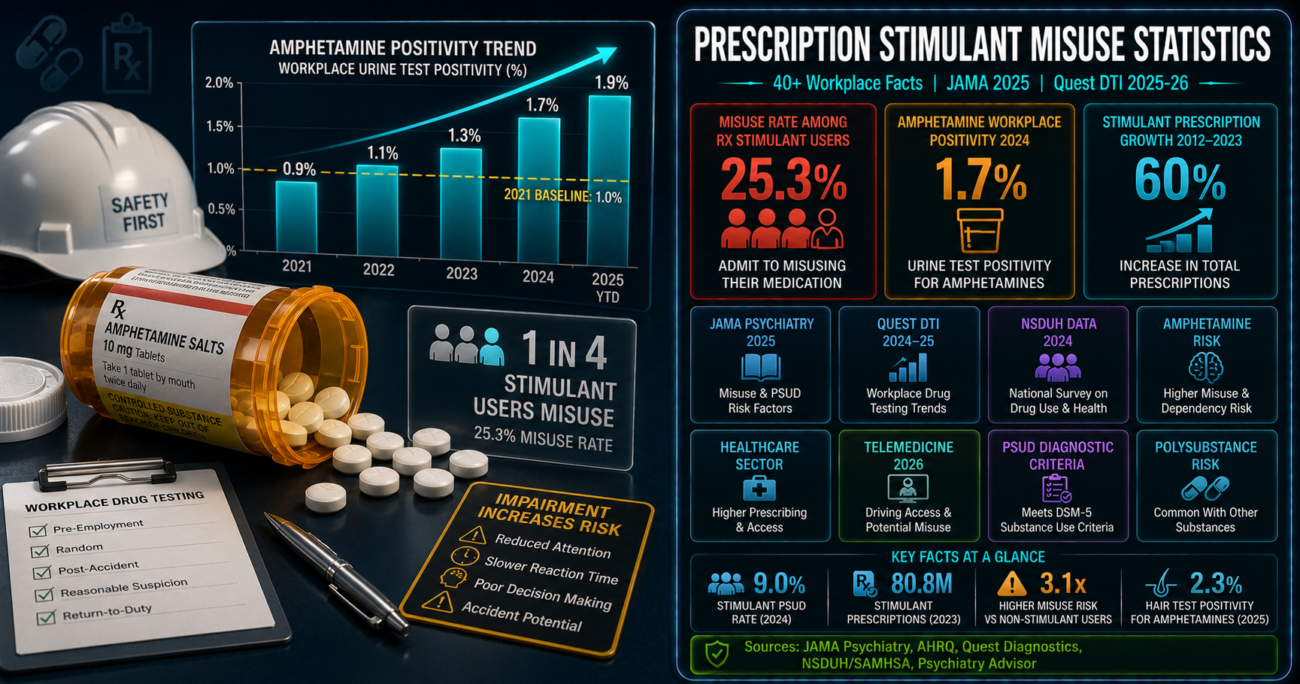
Quest Diagnostics Drug Testing Index data from over 8 million workforce tests shows amphetamine urine positivity rose to 1.7% in 2024 from 1.5% in 2023. This is the second consecutive annual increase and places amphetamines second only to marijuana in general workforce positivity rates. Hair test positivity, which captures a 90-day window rather than a 3-5 day urine window, reached 2.3% for amphetamines in 2025, a 27.8% increase since 2021. Hair testing captures chronic and habitual use patterns that urine testing misses, making the 27.8% hair positivity increase a more meaningful long-term signal than the urine rate alone.
Who Is Misusing: Demographic Breakdown From 2025 JAMA Psychiatry
| Demographic Group | Misuse Rate | Key Finding |
|---|---|---|
| Women aged 18-35 | 36.8% | Highest misuse rate of any demographic group studied. Prescriptions for women 35-64 rose sharply from 2019-2022. |
| Adults aged 18-25 (all genders) | ~30%+ | Campus estimates run as high as 8-20%. Primarily oral use for focus or study. Most common source: friends or relatives. |
| Amphetamine users (vs methylphenidate) | 3.1x higher | Of 5,300 amphetamine users studied, 1,800 reported misuse. Of 680 methylphenidate users, only 90 reported misuse. |
| Adults aged under 30 (2023 data) | 3.7% | Down from 7.8% in 2022 per July 2026 FDA-commissioned review. Decline attributed largely to the medication shortage reducing available supply. |
| Women aged 35-64 | 13.7% | Lowest misuse rate despite experiencing the largest increase in stimulant prescriptions from 2019 to 2022. |
| All US adults prescribed stimulants | 25.3% | Headline figure from JAMA Psychiatry March 2025. 9% of this group met criteria for prescription stimulant use disorder (PSUD). |
Source: JAMA Psychiatry, March 2025 (NIDA/SAMHSA/CDC) | Journal of Clinical Psychopharmacology, July 2026
The Three Workplace Risk Drivers That the Positivity Rate Does Not Capture
Three factors make prescription stimulant misuse harder to manage than illicit drug positivity: the prescription exemption, the difficulty of detecting impairment at standard doses, and the growing counterfeit pill risk in the drug supply.
The Prescription Exemption Problem
A worker who tests positive for amphetamines and produces a valid prescription passes the MRO review. But the 2025 JAMA data shows 25.3% of prescription holders are misusing their medication. The MRO process cannot distinguish use from misuse of a legitimately prescribed drug. Source: JAMA Psychiatry 2025
Polysubstance Use Among High-Frequency Misusers
The 2026 FDA-commissioned review identified a high-frequency misuse group (7+ days per month) that commonly combines stimulants with alcohol, cannabis, or cocaine. A urine test positive for amphetamines alone will not reveal this concurrent use pattern unless the panel includes the other substances. Source: J Clin Psychopharmacol, July 2026
Counterfeit Stimulant Pills in the Drug Supply
With 71.5% of patients reporting difficulty filling ADHD prescriptions at the shortage peak, some users turned to unregulated sources. DEA seizures document counterfeit pills sold as Adderall containing fentanyl. A worker who obtains pills from an informal network faces a fentanyl exposure risk that is not visible in any pre-employment drug screen. Source: DEA One Pill Can Kill Campaign
The Regulatory Landscape: DEA Telemedicine and Employer Implications Through 2026
The pandemic-era telemedicine waivers that allowed prescribing of Schedule II controlled substances, including stimulants, without an in-person evaluation have been extended through the end of 2026. In January 2025, the DEA proposed a new permanent framework for telemedicine prescribing of controlled substances. Until that framework is finalised and in force, the expanded telemedicine prescribing landscape remains in effect. Source: DEA, January 2025
What This Means for Safety-Sensitive Employers
MRO verification of legitimate prescriptions is more complex
Duty-to-accommodate analysis for prescription holders is required
Medical review of safety-sensitive roles must account for stimulant effects
Drug programme policies may need updating to address telemedicine prescriptions
Fitness-for-duty evaluations remain the most defensible safeguard
Source: DEA Telemedicine Proposed Rules, January 2025
How Stimulant Misuse Affects Workplace Safety: 6 Mechanisms
The safety impact of stimulant misuse is not linear. At sub-therapeutic doses taken for focus, the cognitive effects may appear beneficial in the short term. At higher doses, or in combination with other substances, the impairment effects are significant. The following mechanisms are documented in the clinical and occupational safety literature.
Sleep Disruption
Stimulants taken later in the day suppress sleep. A worker who misuses stimulants for shift alertness accumulates sleep debt that impairs next-shift performance and increases incident risk.Cardiovascular Stress
Elevated heart rate and blood pressure. In physically demanding roles or hot environments, stimulant-related cardiovascular load increases heat illness risk and sudden cardiac event probability.Hyperfocus and Tunnel Vision
Stimulants narrow attention. In complex industrial environments where situational awareness across a wide field is required, hyperfocus on one task increases exposure to peripheral hazards.Irritability and Risk Tolerance
High-dose or misuse-pattern stimulant use increases irritability, impulsivity, and risk tolerance. Workers may bypass safety procedures they would otherwise follow, especially under time pressure.Crash and Rebound Impairment
The stimulant crash phase produces fatigue, reduced concentration, and cognitive slowing. A worker who misused a stimulant at the start of a shift may be significantly impaired by the crash phase at its midpoint or end.Masking of Alcohol Impairment
Stimulants mask the subjective perception of alcohol impairment. A worker who has consumed alcohol and taken a stimulant may feel alert and capable while meeting legal impairment thresholds for both substances.Source: SAMHSA National Survey on Drug Use and Health | Occupational Health Clinical Literature Review
9 Important Prescription Stimulant Workplace Facts
What every EHS manager and drug programme administrator should know from the 2025-26 evidence base.
1 in 4 adults with a valid prescription misuses it. A positive drug test cleared by MRO via prescription does not confirm safe or compliant use. Source: JAMA Psychiatry, March 2025
From 50.4 million to 80.8 million prescriptions per year. The workforce population holding valid stimulant prescriptions has grown substantially over the past decade. Source: DEA-Commissioned Report
Hair testing captures a 90-day window vs 3-5 days for urine. The 27.8% hair positivity rise signals growing chronic amphetamine use, not just recent or one-time use. Source: Quest Diagnostics DTI 2025
This shortage-driven gap created demand for unregulated supply channels, including counterfeit pills containing fentanyl. Source: CDC, 2024
Amphetamine-class stimulants (Adderall, Vyvanse) carry a significantly higher misuse risk than methylphenidate (Ritalin, Concerta). Both are Schedule II. Source: JAMA Psychiatry, March 2025
= HIGH RISK High-Frequency Misuse Threshold: 7 or More Days Per Month
July 2026 FDA-commissioned review defines high-frequency misuse as 7+ days per month. This group commonly combines stimulants with alcohol, cannabis, or cocaine. Source: J Clin Psychopharmacol, July 2026
WAIVER END DEA Telemedicine Waivers Run Through End of 2026
Controlled substance prescribing via telemedicine without in-person evaluation remains permitted through end of 2026. Safety-sensitive employers should monitor the post-waiver framework. Source: DEA, January 2025
Meta-analysis of 12 cross-sectional surveys. Past-year diversion rate was 18.2%. Amphetamine prescription was a risk factor for misuse. Source: Frontiers in Psychiatry, June 2025
DOES NOT MEAN SAFE TO OPERATE A Cleared MRO Result Is Not a Fitness-for-Duty Determination
When a worker presents a valid stimulant prescription and the MRO clears the positive test, the employer still has the right and, in safety-sensitive roles, the obligation to conduct a fitness-for-duty evaluation. A legitimate prescription does not authorise impaired operation of equipment. For safety-sensitive positions under DOT, fitness-for-duty evaluation of workers on Schedule II stimulants is a standard component of medical qualification review. Source: DOT Drug and Alcohol Testing Overview
5 Myths About Prescription Stimulants in the Workplace
If a worker has a valid prescription and the MRO clears them, there is no further action needed
MRO clearance confirms the presence of a valid prescription. It does not assess dose, pattern of use, or fitness for duty. With 25.3% of prescription holders misusing their medication, an MRO-cleared result is not a safety determination. For safety-sensitive roles, fitness-for-duty evaluation is the appropriate next step when a prescription for a Schedule II stimulant is disclosed or identified.
Stimulant misuse is declining so the workplace risk is reducing
The July 2026 review shows overall misuse declining among young adults, primarily because the medication shortage reduced available supply. But workplace amphetamine positivity in urine testing rose for two consecutive years (2023 to 2024), and hair test positivity rose 27.8% since 2021. Declining misuse in the general population and rising amphetamine positivity in the working population are not contradictory: the working population and the young adult college-age population are different cohorts.
Stimulants improve performance, so a worker using them is safer and more productive
Therapeutic-dose stimulants prescribed for diagnosed ADHD can improve attention and executive function in that population. In workers without ADHD who misuse stimulants for performance, the effect profile is different: narrowed attention, increased impulsivity, elevated cardiovascular load, and a crash phase of significant fatigue. The “productivity drug” framing ignores the rebound impairment that follows stimulant use.
Standard 5-panel urine testing is sufficient to manage stimulant misuse risk
A 5-panel urine test detects amphetamine presence in a 3-5 day window. It cannot detect chronic use patterns, cannot distinguish therapeutic from misuse doses, cannot identify the polysubstance combination pattern that defines the high-risk group, and cannot detect stimulant use that occurred outside the narrow window. Hair testing, broader panels, and MRO review of prescription validity and dose are the tools that provide a more complete picture.
The ADHD medication shortage has resolved so the counterfeit pill risk has passed
The shortage pushed workers toward informal supply networks during its peak. Workers who obtained pills from these channels during the shortage period may have established purchasing patterns that continued even when legitimate supply improved. DEA seizure data documents ongoing production and distribution of counterfeit stimulant pills containing fentanyl. This risk did not end with the shortage supply improvement.
Impact on Workplace Safety Programmes
Drug Testing Programme Gaps
Programmes built around 5-panel urine testing with MRO prescription exemption are not designed to detect the high-frequency polysubstance misuse pattern that represents the primary safety concern from the 2026 evidence. Panel design and collection protocols need review against the current risk profile.
ADA and Duty-to-Accommodate Complexity
A worker with a legitimate ADHD diagnosis and stimulant prescription may be entitled to accommodation. The accommodation analysis for safety-sensitive roles requires balancing the ADA obligation against the direct threat standard. With more workers holding telemedicine-obtained prescriptions, this analysis is occurring more frequently.
EAP Referral and Awareness Gap
Prescription stimulant misuse does not fit the traditional “drug problem” frame that workers associate with EAP referral. Workers who misuse a medication they are legitimately prescribed are less likely to self-refer or respond to standard substance abuse awareness messaging. EAP communication strategies need to address this specific population.
Policy Update Lag
Many employer drug and alcohol policies were written before telemedicine prescribing became mainstream and before the misuse prevalence data from the 2025 JAMA study was available. Policies that address only illicit drug use or that treat any prescription as automatically safe for safety-sensitive work are outdated against the current evidence.
How to Address Prescription Stimulant Risk in Your Programme
The following actions address the specific gaps identified in the 2025-26 evidence, not generic substance use prevention approaches.
Add Hair Testing for Safety-Sensitive Roles
Hair testing captures a 90-day window and reflects chronic use patterns. A 27.8% rise in hair positivity since 2021 means urine-only programmes are missing a significant share of chronic amphetamine users.
Update Policy to Address Telemedicine Prescriptions
Explicitly address Schedule II medications in your drug policy. Clarify that a valid prescription does not automatically authorise performance of safety-sensitive duties and that fitness-for-duty evaluation may be required.
Implement Fitness-for-Duty Protocol for Schedule II Disclosures
When a worker discloses or tests positive for a Schedule II stimulant, route to an occupational medicine physician for fitness-for-duty evaluation before return to safety-sensitive duties. Document the process.
Train Supervisors on Prescription Stimulant Impairment Signs
Stimulant impairment signs differ from depressant or marijuana impairment. Supervisors need training on elevated heart rate, unusual alertness alternating with crash fatigue, irritability, and risk-taking behaviour as potential indicators.
Expand Panel to Detect Polysubstance Combinations
The high-risk misuse group combines stimulants with alcohol, cannabis, or cocaine. A 5-panel test detects all of these, but alcohol is only detected if an evidential breath test or oral fluid test is included. Review your panel against the polysubstance combination pattern.
Reframe EAP Messaging for Prescription Misuse
EAP materials that only address illicit drug use miss the prescription misuse population. Develop specific messaging that addresses taking prescribed medications at higher doses or more frequently than prescribed, and the specific safety risks in your work environment.
Sources
Government and Regulatory Sources
- DEA: Proposed Telemedicine Rules for Controlled Substances, January 2025: source for the telemedicine prescribing framework and 2026 waiver extension status.
- DEA-Commissioned Report: Stimulant Prescribing Trends: source for the 60% rise in stimulant prescriptions from 50.4 million to 80.8 million dispensed annually from 2012 to 2023.
- DEA: One Pill Can Kill Campaign: source for counterfeit stimulant pills containing fentanyl in the unregulated drug supply.
- CDC: ADHD Medication Shortage and Patient Impact, 2024: source for the 71.5% of ADHD patients reporting prescription filling difficulty at the shortage peak.
- SAMHSA: National Survey on Drug Use and Health 2023: source for population-level stimulant use and misuse prevalence data used throughout the demographics section.
- DOT: Drug and Alcohol Testing Overview: source for the fitness-for-duty and MRO framework for safety-sensitive positions under DOT regulations.
Research Sources
- JAMA Psychiatry, March 2025 (NIDA/SAMHSA/CDC): primary source for the 25.3% misuse rate, 9% PSUD rate, 3.1x higher amphetamine misuse vs methylphenidate, and demographic breakdown of misuse prevalence.
- Journal of Clinical Psychopharmacology, July 2026 (FDA-commissioned review): source for the decline in overall misuse to 3.7% among adults under 30, the high-frequency misuse group definition, and polysubstance combination pattern data.
- Quest Diagnostics Drug Testing Index 2025: source for amphetamine urine positivity of 1.7% in 2024 (up from 1.5% in 2023) and hair test positivity of 2.3% (up 27.8% since 2021) from over 8 million workplace drug tests.
- Frontiers in Psychiatry, June 2025: Misuse and Diversion of Stimulant Medications (Systematic Review): source for the 22.6% past-year misuse rate and 18.2% diversion rate from meta-analysis of 12 cross-sectional surveys.
Standards and Industry Sources
- DOT Office of Drug and Alcohol Policy and Compliance (ODAPC): regulatory framework for drug testing in safety-sensitive transportation roles, MRO procedures, and fitness-for-duty standards referenced in the employer implications section.
- OSHA: Workplace Substance Abuse Programmes: source for employer obligations under OSHA’s general duty clause and drug-free workplace programme framework.
Related VelSafe Articles
Browse All VelSafe Insights
Evidence-based analysis of workplace safety data, OSHA enforcement trends, and occupational health research for EHS professionals across general industry, healthcare, and manufacturing.
Worker Safety Resources
Practical worker safety resources covering hazard recognition, PPE, emergency response, and substance awareness for frontline workers and supervisors in safety-sensitive industries.