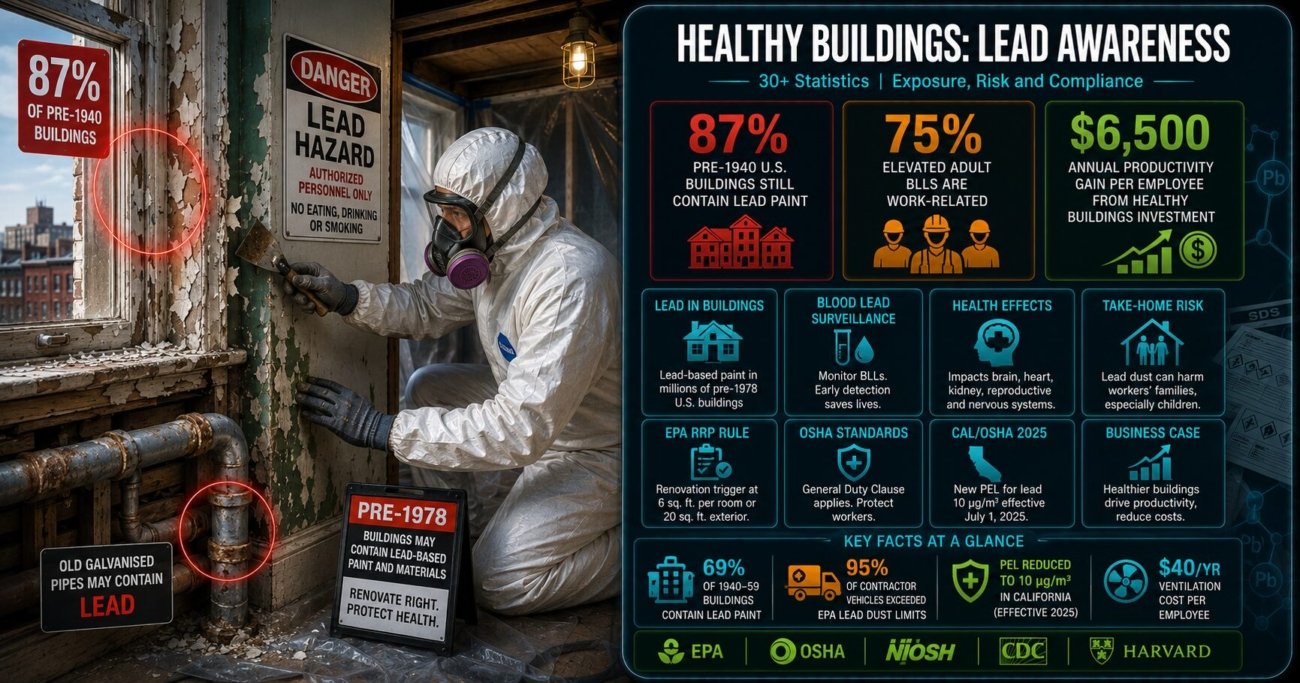
INSIGHTS: Healthy Buildings and Lead Exposure Data
Healthy Buildings: Lead Awareness
30+ Statistics on Exposure, Risk, and Compliance
Lead contamination in buildings remains a significant occupational and public health hazard across the United States. This analysis covers who carries the exposure burden, what OSHA and EPA require, how the regulatory standards compare to current clinical evidence, and where compliance gaps persist.
87%
Pre-1940 Homes with Lead Paint
EPA estimates approximately 87% of homes built before 1940 contain lead-based paint. The proportion drops in later decades but remains significant in structures built through 1977, one year before the 1978 residential ban took effect.
800K
Construction Workers Exposed Yearly
OSHA estimates 800,000 construction workers are exposed to lead each year, primarily during demolition, renovation, bridge painting, and repair work on pre-1978 structures. Construction is the highest-risk sector for occupational lead exposure in the US.
38M
US Homes with Lead-Based Paint
HUD estimates approximately 38 million US homes contain lead-based paint, with around 24 million having significant lead hazards including deteriorating paint, contaminated household dust, or lead-bearing soil around the structure.
Why Lead in Buildings Is Still a 2026 Problem
Lead-based paint was banned for residential use in the US in 1978, but that ban did not remove lead from the tens of millions of structures built in the preceding decades. Every year, renovation, repair, and demolition work disturbs that legacy material and releases lead dust into the air workers breathe and the surfaces building occupants touch. The hazard is not historical; it is present wherever older buildings are being worked on today.
The occupational exposure problem concentrates in construction and building maintenance. Workers who grind, cut, sand, or remove lead-painted surfaces generate airborne lead at levels that can exceed OSHA’s permissible exposure limit many times over without engineering controls. Unlike asbestos, where the primary exposure pathway is inhalation of released fibers, lead also contaminates skin and clothing, spreads to vehicles and homes, and can be ingested as well as inhaled. That multi-pathway exposure means controlling lead requires hygiene practices and decontamination procedures, not just respiratory protection.
Lead Exposure Scale and Building Stock Data
Metric
Figure
Context
Year lead-based paint banned for residential use
1978
The Consumer Product Safety Commission banned lead-based paint for residential use and children’s products in 1978. Industrial and commercial applications continued for years after. Structures built before 1978 represent the primary source of ongoing occupational lead exposure in the building trades.
US homes built before 1978 with lead paint
~40 million
Approximately 40 million US homes built before 1978 contain some lead-based paint. Any renovation, repair, or painting activity that disturbs this material is a potential occupational and public health exposure event under EPA’s RRP Rule and OSHA’s lead in construction standard.
Homes with significant lead hazards (HUD)
~24 million
HUD defines significant lead hazards as deteriorating lead paint, lead-contaminated dust, or lead-bearing soil. These 24 million homes present active exposure risk for occupants and elevated risk for any maintenance or renovation workers who enter them.
Construction workers exposed to lead annually
~800,000
OSHA’s estimate covers demolition, renovation, bridge and highway work, and painting on older structures. Construction is the highest-risk sector for occupational lead exposure because it accounts for the largest share of work that disturbs lead-containing materials.
Blood Lead Level Data and Health Effects
Blood lead level (BLL) is the primary biomarker used to assess occupational lead exposure. OSHA’s lead in construction standard (29 CFR 1926.62) requires medical removal of workers whose BLL reaches 50 µg/dL and prohibits their return to lead-exposed work until BLL falls below 40 µg/dL. These thresholds were established based on evidence available when the standard was written. Since then, the clinical evidence base has shifted substantially.
Metric
Figure
Context
CDC adult blood lead reference value (2021)
3.5 µg/dL
CDC lowered the adult blood lead reference value to 3.5 µg/dL in 2021, reflecting evidence that cardiovascular, renal, and neurological effects begin at levels well below OSHA’s current action level of 30 µg/dL. The gap between the clinical reference value and the occupational action level is significant and represents an area of ongoing regulatory discussion.
OSHA lead action level (construction)
30 µg/m³ air
At or above 30 µg/m³ as an 8-hour TWA, employers must begin blood lead monitoring, medical surveillance, and provide engineering controls. The action level triggers obligations before the worker reaches the PEL.
OSHA lead PEL (construction)
50 µg/m³ TWA
Set under 29 CFR 1926.62. Medical removal applies when blood lead reaches 50 µg/dL. Employers must pay medical removal protection benefits during removal periods. The standard has not been substantially revised since 1993.
Workers with elevated BLL reported (NIOSH ABLES)
~10,000/year
NIOSH’s Adult Blood Lead Epidemiology and Surveillance program reports approximately 10,000 workers annually with elevated BLLs. Over 75% of adult elevated BLL cases in the ABLES program are occupational in origin, with construction accounting for a significant share.
Health systems affected by lead exposure
Multiple
Lead affects the nervous system, kidneys, cardiovascular system, and reproductive system. Chronic low-level occupational exposure is associated with hypertension, reduced kidney function, cognitive effects, and elevated cardiovascular mortality risk, all at levels below OSHA’s current medical removal threshold.
Three Regulatory Frameworks, One Hazard
Lead in buildings is governed by three distinct federal regulatory frameworks, each targeting a different exposure pathway. Construction employers and building owners must understand which frameworks apply to their specific activities, because compliance with one does not ensure compliance with the others.
Framework
Agency
Who It Protects and When It Applies
Citation
Lead in Construction Standard
OSHA
Protects workers during demolition, renovation, repair, and painting on structures containing lead. Requires exposure assessment, engineering controls, PPE, hygiene facilities, blood lead monitoring, and medical removal at threshold BLLs.
29 CFR 1926.62
Renovation, Repair and Painting Rule
EPA
Protects occupants, particularly children, during renovation work in pre-1978 housing and child-occupied facilities. Applies when work disturbs more than 6 sq ft of lead paint per room indoors or 20 sq ft outdoors. Requires contractor certification, lead-safe work practices, and post-work cleaning verification.
40 CFR Part 745
Lead Safe Housing Rule
HUD
Applies to federally assisted housing built before 1978, including public housing, HUD-assisted multifamily housing, and properties financed with federal mortgage programs. Requires lead hazard evaluation and reduction activities with defined disclosure and reporting obligations.
24 CFR Part 35
A contractor performing renovation work in a pre-1978 home must comply with both the OSHA lead standard (protecting their workers) and the EPA RRP Rule (protecting the building’s occupants). If the property receives federal housing assistance, HUD’s Lead Safe Housing Rule adds a third layer of requirements. Treating these as three separate compliance exercises misses the point: the hazard is the same, and controlling it at the source through proper work practices protects everyone.
EPA RRP Certification and Compliance Gaps
Metric
Figure
Context
EPA-certified RRP contractor firms
~100,000
Approximately 100,000 firms are certified under EPA’s RRP program to perform lead-safe renovation work. Given the millions of pre-1978 structures in the US, uncertified work remains a widespread compliance gap. EPA enforcement actions for RRP violations have resulted in penalties ranging from thousands to hundreds of thousands of dollars.
RRP applicability threshold (indoor)
6 sq ft per room
The RRP Rule applies when renovation activities disturb more than 6 square feet of painted surface per room indoors, or more than 20 square feet outdoors, in pre-1978 target housing or child-occupied facilities. Small repairs that stay below these thresholds are exempt but still require lead-safe practices where lead paint is present.
States with EPA-authorized RRP programs
Over 15
More than 15 states and territories have received EPA authorization to administer their own RRP programs, which must be at least as stringent as the federal rule. Contractors operating in these states must comply with state program requirements, which may differ in certification renewal cycles or training requirements.
Key Takeaways
The Work Is the Hazard, Not the Paint
Lead paint in intact, undisturbed condition poses limited immediate risk. It is renovation, repair, and demolition that generates airborne lead dust and debris. Every grinding, cutting, sanding, or demolition task on a pre-1978 structure is a potential exposure event that requires engineering controls before respiratory protection.
OSHA’s Thresholds Lag Clinical Evidence
CDC’s 2021 decision to lower the adult blood lead reference value to 3.5 µg/dL reflects scientific consensus that adverse health effects occur at levels far below OSHA’s current medical removal threshold of 50 µg/dL. Employers who wait for medical removal thresholds to trigger action are permitting harm that current clinical evidence says is avoidable.
Three Frameworks Govern One Problem
OSHA protects workers, EPA protects occupants during renovation, and HUD protects tenants in federally assisted housing. Compliance with one framework does not satisfy the others. Contractors working on older structures need to understand which frameworks apply to each project and ensure their work practices satisfy all applicable requirements simultaneously.
Frequently Asked Questions
What triggers OSHA’s lead standard in construction?
OSHA’s lead in construction standard (29 CFR 1926.62) applies to construction work where workers may be occupationally exposed to lead. Trigger activities include demolition, renovation, repair, and painting on structures containing lead-based paint. The standard requires an initial exposure determination for any task likely to disturb lead-containing materials. If exposures may be at or above the action level of 30 µg/m³, full compliance obligations including engineering controls, hygiene facilities, PPE, blood lead monitoring, and medical surveillance apply.
Does the EPA RRP Rule apply to commercial buildings?
No. The EPA RRP Rule (40 CFR Part 745) applies to pre-1978 target housing (residential dwellings) and child-occupied facilities such as schools and daycare centers. Commercial buildings and industrial structures are not covered by the RRP Rule. Work on commercial structures containing lead paint is governed by OSHA’s lead in construction standard, which protects the workers performing the work, not building occupants.
What is the difference between the OSHA action level and PEL for lead?
The OSHA action level for lead in construction is 30 µg/m³ as an 8-hour time-weighted average. At or above this level, employers must initiate blood lead monitoring, provide medical surveillance, and implement engineering controls. The permissible exposure limit (PEL) is 50 µg/m³ as an 8-hour TWA. Exposures above the PEL require additional controls and trigger medical removal obligations at specific blood lead thresholds. The action level triggers preventive obligations before the PEL is reached.
Why did CDC lower the adult blood lead reference value in 2021?
CDC lowered the adult blood lead reference value from 10 µg/dL to 3.5 µg/dL in 2021 because research had accumulated showing that adverse cardiovascular, renal, and neurological effects occur at blood lead levels well below the previous value. The reference value is not an OSHA regulatory limit; it is a clinical benchmark indicating when a worker’s blood lead level warrants medical evaluation and consideration of exposure reduction. OSHA’s occupational action level and medical removal thresholds have not yet been updated to align with this revised clinical evidence.
Government and Regulatory Sources
Related VelSafe Articles
Lead Compliance Requires Understanding All Three Frameworks
The 800,000 construction workers exposed to lead each year, the 40 million homes containing lead-based paint, and the widening gap between OSHA’s occupational thresholds and CDC’s clinical reference value all point to the same conclusion: lead in buildings is an active problem with evolving standards and persistent compliance gaps. Contractors, building owners, and safety managers who understand the OSHA, EPA, and HUD frameworks and apply them together protect their workers, their occupants, and themselves. Find more healthy buildings and occupational health resources at velsafe.com.