
SITUATIONAL: Pharmaceutical and Biologic Promotion Compliance
The regulation of prescription drug and biologic promotion in the United States requires pharmaceutical and biotechnology sales and marketing professionals to navigate a complex set of FDA requirements governing what can be said, shown, and implied about a product. When these boundaries are crossed, the consequences range from FDA Warning Letters and untitled letters to False Claims Act enforcement and multi-hundred-million-dollar settlements. This situational case examines how promotional violations develop and what systems prevent them.
Situational articles use composite scenarios drawn from documented enforcement patterns and publicly available FDA and DOJ records. Specific identifying details are illustrative. All regulatory references are real.
$500M+
Average DOJ FCA Settlement for Off-Label Promotion
Department of Justice False Claims Act settlements for pharmaceutical off-label promotion frequently exceed $500 million. Several exceed $1 billion. The FCA is the primary enforcement mechanism after FDA identifies promotional violations that caused federal health programme reimbursement of off-label uses.
DOJ, False Claims Act Enforcement
DDMAC
Now OPDP: FDA’s Promotional Enforcement Office
FDA’s Office of Prescription Drug Promotion (OPDP) reviews pharmaceutical promotional materials, issues Warning Letters and untitled letters for violations, and publishes enforcement correspondence publicly. OPDP reviews materials including advertisements, detail aids, websites, speaker programme content, and social media.
FDA, Office of Prescription Drug Promotion (OPDP)
FCA
The Enforcement Bridge From FDA to DOJ
The False Claims Act allows the federal government and qui tam relators to pursue pharmaceutical companies that promoted drugs off-label where federal health programmes (Medicare, Medicaid) reimbursed those off-label uses. FCA liability attaches to the promotion, not just the prescription, creating downstream enforcement exposure from promotional conduct.
DOJ, False Claims Act
Situation Overview
Setting
A mid-size pharmaceutical company with an approved branded drug for a narrow approved indication. The commercial organisation is under significant pressure to grow revenue beyond the approved patient population.
Conduct
Sales representatives directed to discuss the drug’s potential efficacy in broader patient populations not covered by the approved label. Regional managers provided “educational” messaging guides describing off-label scenarios to use with physicians.
Detection
A former sales representative filed a qui tam lawsuit under the False Claims Act. DOJ opened an investigation. FDA OPDP issued a Warning Letter following receipt of the FDA detail aid submitted under 21 CFR 314.81(b)(3)(i) that included comparative efficacy claims not supported by substantial evidence.
Outcome
DOJ settlement resolving FCA liability. Corporate Integrity Agreement with the HHS Office of Inspector General requiring five years of compliance monitoring, independent review organization audits, and senior leadership certifications. Total financial exposure in nine figures.
What Happened: Three Promotional Failures That Combined to Create the Violation
Failure 1: Off-Label Promotion Through Sales Channels
Sales representatives who communicate about unapproved uses of an approved drug are conducting off-label promotion, regardless of whether the communication is described as “educational,” “informational,” or based on “published data.” The FD&C Act prohibits manufacturers from promoting drugs for unapproved uses. The commercial intent of the communication, not its format or label, determines whether it constitutes promotion. Representative messaging guides that include off-label scenarios are promotional materials, not educational materials.
FDA, Advertising and Promotion Guidance
Failure 2: Unsupported Comparative Efficacy Claims
Under FDA’s regulations, comparative efficacy claims (claims that a drug is more effective or better than a comparator) require substantial evidence, typically from adequate and well-controlled clinical trials comparing the two products head-to-head. Using published observational studies, registry data, or single-arm trial data to imply comparative superiority does not meet this standard. A detail aid that presents a drug’s outcomes in terms that imply superiority over a comparator without head-to-head trial data makes an unsupported comparative claim regardless of how the comparison is framed.
FDA OPDP, Comparative Claims Guidance
Failure 3: Inadequate Medical Affairs Firewall
Medical affairs functions (Medical Science Liaisons, medical information) may engage in scientific exchange with healthcare providers, including discussion of off-label data, in response to unsolicited requests. Commercial functions (sales representatives, marketing) may not. The distinction requires a genuine organisational firewall: MSLs must not report to sales leadership, must not be evaluated on commercial metrics, and must not be directed to deliver off-label messaging as a sales tool. When the firewall collapses under commercial pressure, both the scientific exchange privilege and the compliance defence disappear.
FDA, Guidance on Responding to Unsolicited Requests for Off-Label Information
Incident Timeline: How the Violation Developed and Was Detected
Year 1
Commercial Launch With Narrow Label
Product receives FDA approval for a specific indication. The approved label covers a narrower patient population than the company’s market model projected. Commercial leadership begins internal discussion of “label expansion” messaging and “disease awareness” campaigns that anticipate a future supplemental approval.
Year 2
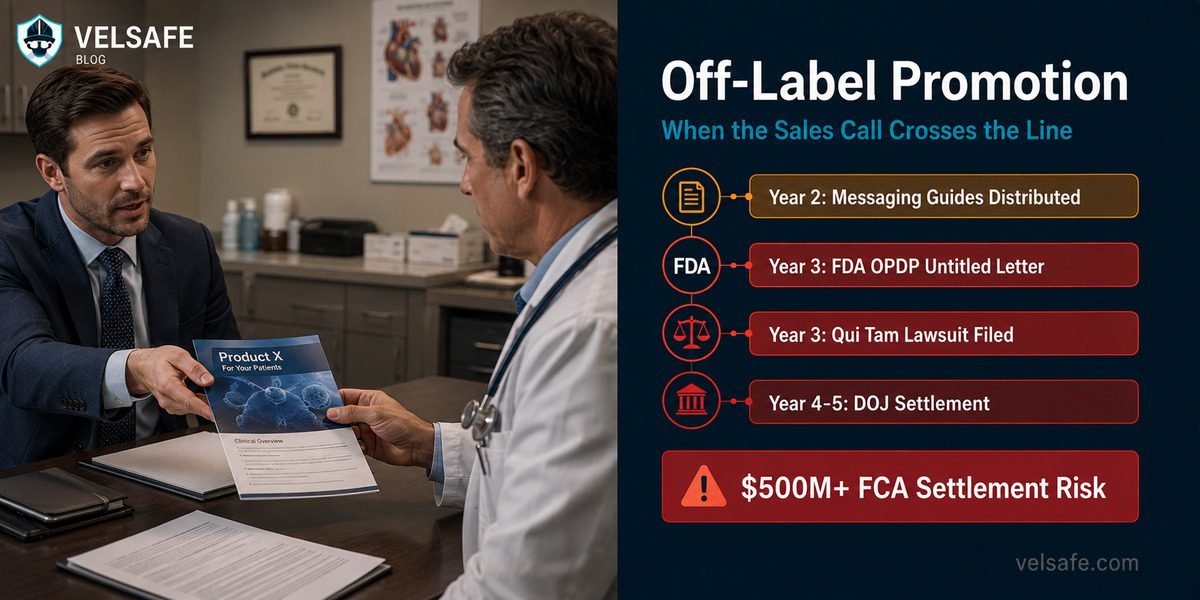
Regional Manager “Messaging Guides” Distributed
Regional sales managers develop and distribute internal “messaging guides” describing how to discuss the drug’s potential utility in broader patient populations. The guides use clinical language and reference unpublished data from ongoing trials. Representatives are trained on the messaging at regional meetings.
Year 2-3
Detail Aid Submitted to FDA Contains Unsupported Claims
A new detail aid developed by the marketing team is submitted to FDA OPDP under the required promotional material submission process. OPDP reviewers identify comparative efficacy claims that are not supported by adequate and well-controlled head-to-head trials. An untitled letter is issued requesting the company cease distribution of the material.
Year 3
Qui Tam Lawsuit Filed by Former Representative
A former sales representative files a qui tam lawsuit under the False Claims Act, alleging that the company’s off-label promotion caused Medicare and Medicaid to reimburse claims for off-label uses. DOJ opens an investigation. The company’s legal team begins document preservation and internal review.
Year 4-5
DOJ Investigation and Resolution
DOJ investigation reviews sales call records, internal messaging guides, representative emails, and speaker programme transcripts. Settlement reached including monetary payment to resolve FCA liability and a Corporate Integrity Agreement with OIG requiring five years of compliance monitoring and annual certification by the CEO and compliance officer.
Root Cause Analysis: What Allowed the Violations to Occur
Root Cause Contribution by Category
Commercial pressure overriding compliance boundariesPrimary
Revenue pressure from senior leadership created an environment in which commercial messages were developed without adequate regulatory review and distributed without MLR committee approval.
Inadequate Medical, Legal, Regulatory (MLR) reviewPrimary
The regional messaging guides were created and distributed by regional managers without going through the company’s MLR review and approval process that existed for formal promotional materials.
Medical affairs firewall not maintainedContributing
MSLs were directed by regional sales leadership to support “scientific discussions” that were in practice delivery of off-label messaging, blurring the commercial/medical firewall.
Insufficient representative training on promotional complianceContributing
Representatives received compliance training at hire but annual refreshers were generic. Specific training on the distinction between approved and off-label uses of this product, and the prohibition on promotional discussions of off-label uses, was not part of the annual curriculum.
FDA OPDP Enforcement Letters | DOJ FCA Enforcement
Lessons Learned: What Effective Promotional Compliance Requires
Every Promotional Material Requires MLR Approval
The Medical, Legal, and Regulatory review process exists to ensure that every piece of promotional content, including internal messaging guides and regional sales tools, has been reviewed for regulatory compliance before distribution. Materials created by sales management that bypass MLR review carry the same regulatory risk as formally produced promotional materials that bypass review, with the added risk that internal distribution makes enforcement discovery more likely through qui tam whistleblowers.
The Commercial/Medical Firewall Is Not Theoretical
MSLs who report to sales leadership, are evaluated on prescription volume, or are directed by regional managers to deliver scientific discussions to specific physicians are operating in a commercially compromised position. When a DOJ investigation reviews MSL call reports and internal emails, any evidence that MSL activity was commercially directed rather than responding to unsolicited requests destroys the scientific exchange privilege and creates FCA exposure for every federal health programme reimbursement of the relevant off-label use.
Revenue Pressure Does Not Change the Legal Standard
Commercial pressure from senior leadership does not create a compliance exception. The FD&C Act’s prohibition on off-label promotion applies regardless of the company’s market assumptions, the supplemental application timeline, or the degree to which physicians already use the product off-label. Sales representatives who comply with the promotional regulations despite commercial pressure from management are protected; those who act on the pressure are not.
Key Takeaways
Off-Label Promotion Is Prohibited Regardless of How It Is Framed
Commercial communications about unapproved uses of approved drugs, whether labelled educational, informational, or data-based, constitute off-label promotion under the FD&C Act when conducted by sales and marketing personnel.
The False Claims Act Creates the Largest Financial Exposure
FDA Warning Letters and enforcement are one consequence of off-label promotion. When federal health programmes reimburse the off-label uses promoted, FCA liability is the dominant financial exposure, with settlements frequently exceeding nine figures and structured compliance programmes lasting years.
Qui Tam Whistleblowers Are the Primary Detection Mechanism
Most pharmaceutical FCA enforcement actions originate with current or former employees who file qui tam lawsuits. Internal sales messaging guides, representative emails, call reports, and speaker programme materials are all discoverable in FCA investigations. The evidentiary trail that builds an FCA case is created by the commercial organisation’s own documentation.
Every Promotional Piece Needs MLR Review Before Distribution
The MLR review process is not a formality. It is the control that catches compliance violations before they reach physicians, patients, federal auditors, or DOJ investigators. Bypassing MLR review for regional sales tools, speaker programme slide decks, or informal representative materials removes the only pre-distribution filter available.
Frequently Asked Questions
What is the difference between off-label prescribing and off-label promotion?
Off-label prescribing is the physician’s legal decision to prescribe an approved drug for an unapproved use. Physicians may lawfully prescribe any approved drug for any indication they believe is clinically appropriate. Off-label promotion is the manufacturer’s communication to healthcare providers encouraging use of the drug for an unapproved indication or in a manner inconsistent with the approved labelling. Manufacturers may not promote off-label uses. This distinction is critical: physicians have wide prescribing latitude; manufacturers do not.
What is an FDA Warning Letter versus an untitled letter for promotional violations?
FDA OPDP issues two types of enforcement correspondence for promotional violations. Untitled letters are issued when OPDP believes a promotional material violates the regulations but the violation does not rise to the level that would constitute a misbranding or adulteration violation. Warning Letters are issued for more serious violations, including claims that are false or misleading in a material way. Both require a response and cessation of the violating promotional activity. Warning Letters are posted publicly on FDA’s website, creating reputational consequences beyond the compliance obligation.
Can a pharmaceutical company legally discuss off-label data with physicians?
Yes, under specific conditions. Medical affairs personnel (Medical Science Liaisons) may engage in scientific exchange with healthcare providers about off-label data when the request is unsolicited and the exchange is not commercially directed. Manufacturers may also proactively share certain types of scientific information with healthcare providers under conditions described in FDA’s guidance on scientific exchange and dissemination of medical information. The key distinctions are: who is communicating (medical affairs vs commercial), whether the request was solicited, and whether the communication is commercially driven.
What is the MLR review process and who must participate?
The Medical, Legal, and Regulatory (MLR) review process is the manufacturer’s internal review mechanism for evaluating promotional materials before they are distributed or published. Medical reviewers assess scientific accuracy and fair balance; legal reviewers assess liability and off-label risk; regulatory reviewers assess compliance with FDA promotional requirements. All promotional materials for prescription drugs must go through MLR review before distribution. This includes sales aids, speaker programme slides, website content, patient materials, social media posts, and internal sales training materials with promotional content. Regional or informal sales messaging materials are not exempt from this requirement.
What is a Corporate Integrity Agreement (CIA) and how does it affect operations?
A Corporate Integrity Agreement is a compliance programme required by the HHS Office of Inspector General as a condition of continued participation in federal health programmes following an FCA or other compliance settlement. CIAs typically require five years of enhanced compliance measures including: an independent review organisation (IRO) that audits promotional materials, financial arrangements, and field activities; annual compliance certification by the CEO, compliance officer, and board; mandatory compliance training; and annual reporting to OIG. A CIA creates a significant ongoing operational burden and compliance overhead that typically exceeds the settlement amount in total cost over the CIA period.
What are the Sunshine Act requirements for pharmaceutical sales and marketing?
The Physician Payments Sunshine Act (now the Open Payments programme) requires pharmaceutical manufacturers to report transfers of value to covered recipients including physicians, nurse practitioners, physician assistants, and teaching hospitals. Reportable transfers include consulting fees, meals, travel, speaker programme payments, grants, royalties, and any other financial relationship exceeding $10.99 per transfer or $10.99 cumulatively per year. Reports are submitted to CMS annually and published publicly in the Open Payments database. Failure to report, or inaccurate reporting, carries civil monetary penalties. All pharma sales and marketing personnel who interact with physicians must understand which interactions create reportable transfers and ensure those interactions are captured in the reporting system.
What must a pharmaceutical representative do if directed by a manager to discuss off-label uses with physicians?
A representative directed by management to discuss off-label uses of a drug with physicians should decline the direction, document the request and their response in writing, and report the direction to the company’s compliance office or ethics hotline. Most pharmaceutical companies have written policies prohibiting off-label promotion and provide protected reporting channels for compliance concerns. Representatives who follow a manager’s direction to conduct off-label promotion are not protected from regulatory or FCA consequences by the manager’s instruction. Whistleblower protections under the FCA extend to employees who report concerns internally or to government authorities; they do not extend to employees who actively participate in the promotional violation.
Government and Regulatory Sources
Government and Regulatory Sources
- FDA. Office of Prescription Drug Promotion (OPDP): Warning Letters, untitled letters, guidance documents, and enforcement correspondence for prescription drug promotional violations.
- FDA. Advertising and Promotion Guidance for Prescription Drugs: regulatory framework for promotional claims, fair balance, comparative claims, and off-label promotion.
- DOJ. False Claims Act: statute, qui tam provisions, enforcement history, and pharmaceutical settlement records.
- HHS OIG. Corporate Integrity Agreements: CIA requirements, monitoring obligations, and published CIAs from pharmaceutical enforcement settlements.
- CMS. Open Payments Program: Sunshine Act reporting requirements, covered recipients, and publicly searchable transfer of value database.
Related VelSafe Articles
Related VelSafe Articles
- Introduction to Medical Device Healthcare Compliance: The Regulatory Framework Every Device Professional Must Understand
- FDA Inspection Preparation Guide for Drug Manufacturers
- Introduction to ESG: The Legal and Regulatory Framework for Employers
- FDA Inspection Interviewing Techniques: 10 GMP Compliance Tips
VelSafe Pharmaceutical Compliance Insights
The Promotion Started With a Messaging Guide. The Settlement Ended in Nine Figures.
Pharmaceutical promotional compliance is a system of controls: MLR review, medical affairs firewalls, representative training, and commercial leadership that understands where the legal boundary is. When any of these controls fails under commercial pressure, the exposure runs from FDA enforcement through DOJ investigation to a settlement and Corporate Integrity Agreement. VelSafe covers pharma promotion compliance, FDA regulatory affairs, and life sciences commercial compliance.
Browse Situational Safety Cases