GUIDES: FDA Inspection Readiness
How to Prepare for an FDA Inspection: A Step-by-Step Guide for Drug Manufacturers
FDA inspections of pharmaceutical manufacturing facilities are not random audits. They follow a structured process, evaluate specific evidence categories, and generate findings that are directly tied to what inspectors observe, read, and hear during the visit. This guide walks drug manufacturers through a complete pre-inspection preparation programme: what to organise, what to train, what to test, and what to do when the investigator arrives.
80%
Inspections Yield Observations
Approximately 80% of FDA pharmaceutical facility inspections result in at least one Form 483 observation. The most common: laboratory controls, CAPA, and production/process controls.
FDA, Pharmaceutical CGMP Inspections, 2024
30
Days to Respond to a Warning Letter
FDA expects an initial response to a Warning Letter within 15 business days. A well-prepared facility can produce a defensible, specific, corrective-action-backed response rather than a generic acknowledgement.
FDA, Warning Letters, 2024
6
Core CGMP Systems Inspectors Evaluate
FDA’s CGMP inspection programme evaluates six quality systems: quality, laboratory controls, production, materials, packaging and labelling, and facilities and equipment. Weakness in any one can generate citations.
FDA, CGMP Inspection Programme Guide
FDA pharmaceutical inspections are conducted under the Compliance Program Guidance Manual (CPGM) 7356.002, which directs investigators to evaluate a facility’s quality systems for compliance with 21 CFR Parts 210 and 211. Inspectors are not looking for a tidy facility on inspection day. They are looking for evidence that the quality system functions correctly on every production day, whether or not an inspector is present.
This distinction is the foundation of effective inspection preparation. A facility that scrambles to organise records, update SOPs, and train employees in the days before an inspection is already behind. The facilities that perform best under FDA scrutiny are those whose inspection preparation is identical to their day-to-day quality operations. This guide is designed for facilities that want to build that kind of programme, not for those trying to paper over gaps in the week before an inspection arrives.
What FDA Investigators Are Specifically Trained to Detect
Freshly updated documents. Inspectors note the revision dates on SOPs and compare them to the inspection date. A batch of SOPs revised within 30 days of an inspection signals reactive compliance, not a functioning quality system. They will ask when the changes were made and why.
Inconsistencies between verbal answers and written records. Investigators interview employees and compare their descriptions of processes to what the SOPs say and what the batch records show. Gaps between these three sources generate 483 observations independent of any physical hazard.
CAPA systems that document without closing. A CAPA system full of open items, repeated root causes, and effectiveness checks that were never completed tells an investigator the system exists on paper but does not drive improvement in practice.
OOS records that end in invalidation. If an investigator reviews laboratory data and finds a pattern of OOS results that were all invalidated rather than investigated to completion, that pattern is a data integrity finding even if each individual invalidation was documented.
FDA, CPGM 7356.002 Pharmaceutical CGMP Inspections
Inspection Finding Frequency by Quality System (Pharmaceutical Facilities)
Quality System (CAPA, management review, internal audit)Most frequent
CAPA deficiencies, inadequate investigations, and failure to verify effectiveness are the most cited findings across pharmaceutical facilities of all sizes.
Laboratory Controls (OOS, analyst training, data integrity)Very frequent
OOS investigation inadequacy, incomplete analyst qualification records, and electronic data integrity failures are leading laboratory citation categories.
Production (batch records, process validation, deviations)Frequent
Batch record completeness, deviation documentation, and process validation gaps are recurring findings. Informal changes to manufacturing steps without change control are a consistent Inspector focus.
Materials (component testing, supplier qualification)Moderate
Inadequate component testing, over-reliance on supplier CoAs without validation, and unsegregated quarantine areas generate findings in this system.
Packaging and Labelling (label reconciliation, line clearance)Moderate
Label reconciliation failures, inadequate line clearance verification, and labelling mix-up prevention gaps are typical findings in this system.
Facilities and Equipment (calibration, cleaning validation)Common
Calibration overdue items, cleaning validation gaps, and equipment qualification record deficiencies are typical in this system. Often found during facility walkthrough.
FDA, CPGM 7356.002
Problem: Mock inspection identified too many gaps to close before the real inspection
Root cause: Preparation started too late or the quality programme has structural gaps that cannot be fixed quickly.
Fix: Prioritise by risk to patient safety and regulatory visibility. Close CAPA, laboratory, and production findings first, as these are highest citation frequency. For gaps that cannot be fully closed, prepare a written corrective action plan with specific timelines to present proactively to the investigator at the closing conference. Proactive disclosure with a credible corrective action plan is substantially better than reactive discovery.
Problem: Employees give inconsistent or inaccurate answers during mock interviews
Root cause: Employees know how to do their jobs but cannot accurately describe them in interview format, or there is a gap between what the SOP says and what employees actually do.
Fix: If it is an articulation problem, practice more until employees are comfortable referencing SOPs and describing processes accurately. If it is a practice-procedure gap, update the procedure to reflect actual practice or retrain employees on the correct practice. Never train employees to describe a process that they do not actually follow.
Problem: The inspection starts before preparation is complete
Root cause: FDA does not give advance notice for most domestic inspections. An investigator may arrive on any business day.
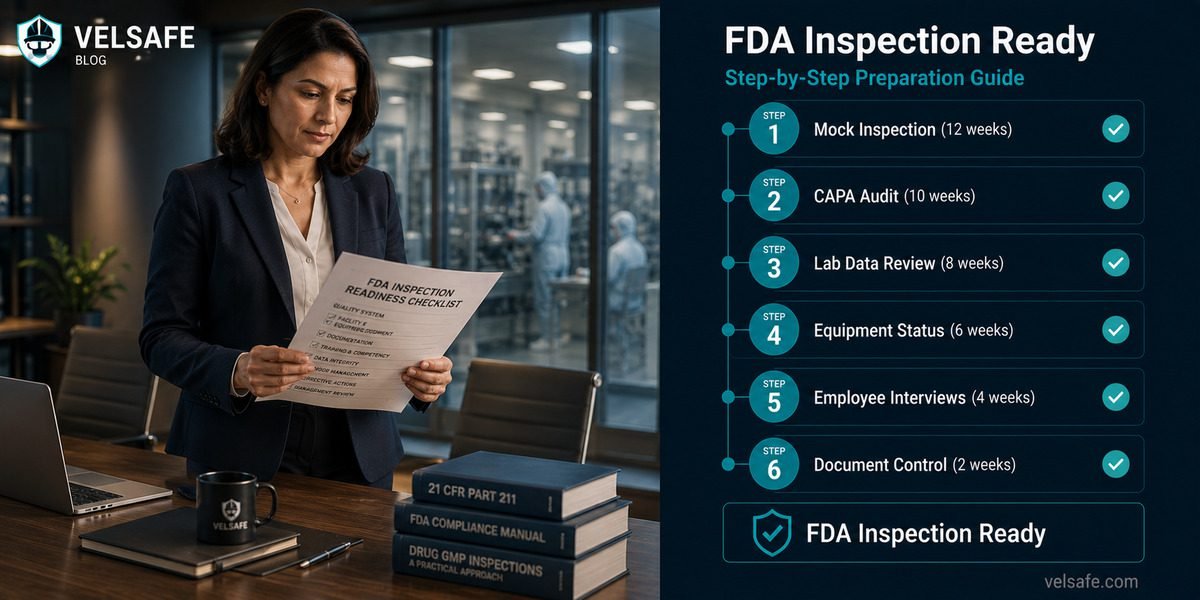
Fix: The inspection readiness programme in this guide is a continuous programme, not a one-time project. Facilities that run this programme year-round are always at approximately week-two readiness, which means the mock inspection, CAPA review, and laboratory audit have been completed within the prior 12 weeks. If an inspection arrives at week eight of a first-time preparation cycle, focus the remaining time on employee interview training and document organisation. Accept that some findings may occur and prioritise responding well.
Inspection Preparation Is a Year-Round Quality Activity
The facilities that perform best under FDA scrutiny operate the same way whether or not an inspection is imminent. Build this programme into your annual quality management plan, not your inspection response plan.
CAPA Is the Single Highest-Risk Quality System
An investigator who opens your CAPA log within the first hour of an inspection will form an assessment of your entire quality programme from what they see there. A well-managed, current, documented CAPA system with verified effectiveness demonstrates systemic quality discipline across all other systems.
Employee Interviews Can Generate Findings Independently
A 483 observation can arise entirely from what an employee says during an interview, even if the underlying records are compliant. Employees who over-answer, speculate, or describe processes inconsistently with their SOPs create citations. Interview preparation is not coaching: it is compliance training.
Data Integrity Is a Primary Inspection Focus
FDA’s data integrity guidance, Warning Letter patterns, and inspection training all point to electronic audit trails, chromatography data management, and OOS invalidation patterns as primary investigation targets. Laboratory data integrity preparation is not optional in a modern pharmaceutical inspection.
Proactive Disclosure Outperforms Reactive Discovery
When a facility identifies a gap during inspection preparation that cannot be fully closed before the inspection, proactively disclosing it to the investigator with a documented corrective action plan reduces the observation’s severity and demonstrates systemic quality awareness. Attempting to hide gaps that FDA will likely find creates a worse outcome than transparent, controlled disclosure.
Reading Warning Letters Is Part of Inspection Preparation
FDA Warning Letters are publicly available and describe exactly what FDA is currently citing in your industry. Reviewing the prior 12 months of pharmaceutical Warning Letters as part of every annual inspection preparation cycle tells you which findings are trending and which quality systems are under heightened scrutiny.
Does FDA give advance notice before inspecting a pharmaceutical facility?
For most domestic pharmaceutical facility inspections, FDA does not provide advance notice. An investigator may arrive unannounced on any business day. Pre-Approval Inspections (PAIs) associated with pending NDA or ANDA submissions are an exception: the applicant is typically notified. For-cause inspections triggered by a serious adverse event or recall are always unannounced. The absence of advance notice is the primary reason inspection readiness must be a year-round programme rather than a reactive sprint.
How long does an FDA pharmaceutical facility inspection typically last?
Routine surveillance inspections of pharmaceutical facilities typically last two to five days, depending on facility size, product complexity, and the number of investigators assigned. A PAI may be shorter (one to two days) if the facility and application are straightforward. A for-cause inspection or one triggered by a consumer complaint can extend to two weeks or more if the investigator identifies significant issues requiring deeper review. The facility has no control over inspection duration once the investigator is on site.
Can a facility refuse an FDA inspection?
A facility can refuse entry to an FDA investigator, but this refusal is itself a prohibited act under Section 301 of the FD&C Act and can result in seizure of the facility’s products, injunction, or criminal referral. In practice, refusal to permit an inspection is treated as evidence of the most serious compliance failures. Legal counsel may be appropriate before an inspection begins, particularly for complex investigations, but refusal of entry is rarely a defensible position and almost always makes the regulatory situation worse.
What happens after an FDA investigator issues a Form 483?
After receiving a Form 483, best practice is to respond in writing within 15 business days with a response that addresses every observation specifically: root cause, corrective action, implementation timeline, and verification method. FDA is not legally required to accept the response, but a prompt, specific, technically credible response substantially reduces the probability of the observation escalating to a Warning Letter. Vague or generic responses (“we will improve our training”) without specific actions and timelines are treated as inadequate and increase the likelihood of escalation.
What documents should a facility always have ready for immediate production during an inspection?
The core documents most frequently requested in the first day of a pharmaceutical inspection include: the site master file or facility overview, SOPs for the primary manufacturing and QC operations, the CAPA log with current status, the deviation log for the prior 12 to 24 months, training records for the employees the investigator has already spoken to, batch records for products currently in production or recently released, calibration and qualification records for equipment in areas already toured, and the most recent annual product review. Having these indexed and retrievable within 10 minutes is a significant inspection management advantage.
How should a facility respond if an investigator asks to see a document that reveals an unresolved compliance gap?
Provide the document. Withholding a requested document from an FDA investigator is obstruction, which is treated far more seriously than the underlying compliance gap the document reveals. Before providing the document, confirm in the back room that you understand what it shows, have a factual explanation prepared, and know whether a corrective action is already in progress. Present the document with the corrective action context where appropriate. The investigator will evaluate the gap in the context of whether the facility recognised it and responded to it, which is a materially better position than having it discovered during an evidence-gathering exercise.
What is a Pre-Approval Inspection (PAI) and how does it differ from a routine inspection?
A Pre-Approval Inspection (PAI) is triggered by a pending NDA, ANDA, BLA, or supplemental application and is conducted to verify that the manufacturing facility and processes described in the application are capable of consistently producing the product to specification. Unlike a routine surveillance inspection, a PAI is focused specifically on the product and process described in the pending application, though investigators may expand scope if they observe significant CGMP issues during the visit. A PAI outcome of Official Action Indicated (OAI) results in the application being placed on hold until the cited issues are resolved, which directly blocks product approval.
VelSafe Compliance Guides
The Best FDA Inspection Is the One You Were Already Ready For
CAPA systems, laboratory data integrity, employee interview readiness, and document control are not inspection preparation activities. They are quality operations that happen to make inspection preparation unnecessary. VelSafe covers pharmaceutical CGMP compliance, FDA inspection readiness, and quality system design for regulatory and quality professionals.
Browse Compliance Guides