SITUATIONAL: Global Regulatory
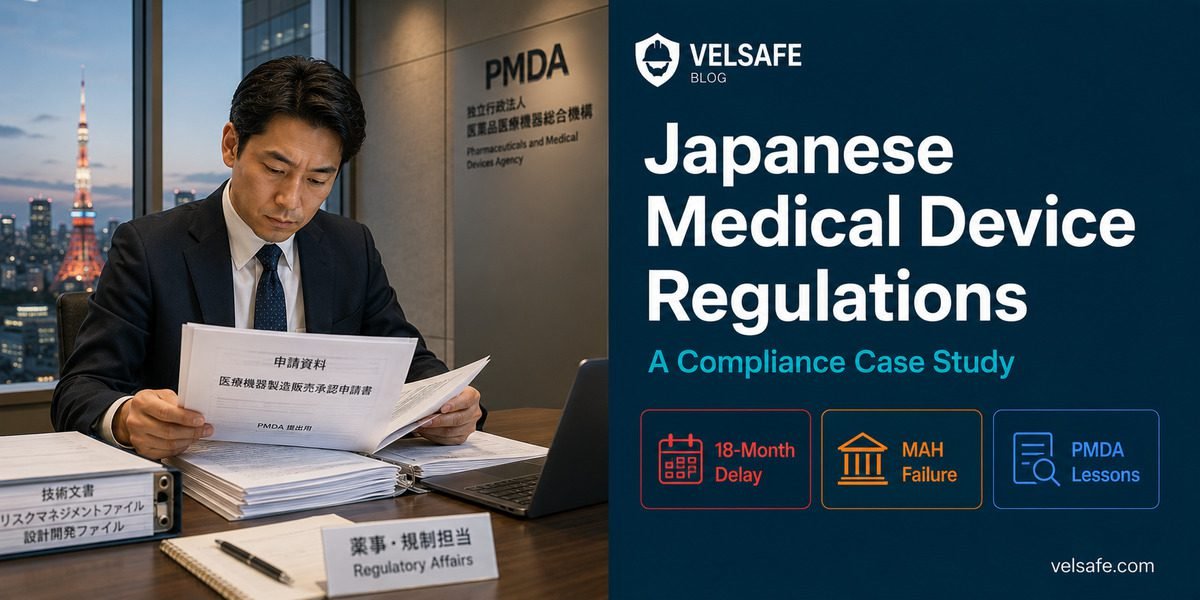
A composite case study illustrating what happens when a foreign manufacturer enters the Japanese market without fully understanding PMDA requirements, the MAH system, and post-market obligations.
Note: This is a composite educational scenario based on common regulatory patterns. It does not represent a specific company or enforcement action.
PMDA
Primary Regulator
The Pharmaceuticals and Medical Devices Agency oversees approval, safety, and post-market surveillance for all drugs and devices in Japan
PMDA, pmda.go.jp
MAH
Required Role
Foreign manufacturers must appoint a Japan-based Marketing Authorisation Holder. The MAH holds the product licence and bears regulatory responsibility
PMDA, Pharmaceutical Affairs Law
SAKIGAKE
Priority Review Path
Japan’s Sakigake designation provides priority review for innovative products but requires earlier and deeper PMDA engagement than standard pathways
PMDA, Sakigake Designation
Company
A mid-size European medical device manufacturer seeking first-entry into the Japanese market with a Class III implantable device
Regulatory Situation
CE-marked product with FDA 510(k) clearance. Team assumed Japan approval would be straightforward given existing global approvals
Outcome
18-month market entry delay, rejection of initial application, mandatory re-submission with Japan-specific clinical data, and MAH relationship restructuring
Root Cause
Underestimation of Japan-specific regulatory requirements, insufficient PMDA pre-submission engagement, and inadequate MAH selection and oversight
Japan is the third largest pharmaceutical and medical device market in the world. Access to it is governed by the Act on Securing Quality, Efficacy and Safety of Products Including Pharmaceuticals and Medical Devices (the Pharmaceuticals and Medical Devices Act, or PMDA). The Pharmaceuticals and Medical Devices Agency (PMDA) handles scientific review, and the Ministry of Health, Labour and Welfare (MHLW) issues formal approvals.
Foreign manufacturers cannot hold a Japanese product licence directly. They must appoint a Japan-based Marketing Authorisation Holder (MAH), a licensed entity that takes legal and regulatory responsibility for the product in Japan. The MAH applies for approval, responds to PMDA queries, manages post-market safety reporting, and is the point of contact for all regulatory communications. Choosing the wrong MAH, or failing to manage the MAH relationship properly, is one of the most common reasons foreign companies struggle with Japanese market access.
Japan also maintains its own clinical data requirements. For many device categories, particularly Class III devices, PMDA may require Japan-specific clinical data even when robust global clinical evidence exists. The assumption that CE marking or FDA clearance automatically satisfies Japanese evidence requirements has delayed market entry for numerous foreign manufacturers.
Failure 1: Assuming regulatory reciprocity where none exists
The team assumed that CE marking and FDA clearance would be treated by PMDA as substantially equivalent evidence bases. Japan maintains its own evidence standards. For Class III devices, PMDA frequently requires clinical data from Japanese subjects to evaluate whether device performance and safety profiles observed globally apply to the Japanese population. This is particularly relevant for implantable devices where anatomical and physiological differences across populations may be clinically significant.
Failure 2: Inadequate MAH selection and governance
The MAH is not simply a local agent. Under Japanese law, the MAH bears regulatory responsibility for the product, including post-market safety reporting, adverse event notification, and responding to PMDA queries. Selecting an MAH based on commercial relationships rather than demonstrated regulatory capability for the specific product class is a critical error. The absence of a formal MAH agreement that defines responsibilities, communication protocols, and escalation procedures compounded the problem significantly.
Failure 3: Skipping PMDA pre-submission consultation
PMDA offers pre-submission consultation meetings that allow manufacturers to discuss the proposed dossier structure, clinical data requirements, and any specific concerns before formal submission. These meetings are not administrative. They identify submission gaps before they become formal deficiency letters. The decision to skip the pre-submission consultation to save time ultimately added 14 months to the market entry timeline.
No Japan-specific clinical data
Assumption that CE/FDA data was sufficient
Critical
MAH without device regulatory competence
Commercial relationship used as selection criterion
Critical
No formal MAH agreement
Relationship treated as commercial, not regulatory
Critical
PMDA pre-submission consultation skipped
Timeline pressure prioritised over due diligence
High
Dossier translation quality issues
Non-specialist translation used to reduce cost
High
MAH subcontracting without oversight
No MAH governance or monitoring programme
High
Japan requires its own regulatory strategy, not an adaptation of your global one
CE marking and FDA clearance are not substitutes for Japanese regulatory engagement. Japan has its own clinical data requirements, its own device classification system, its own GMP standards (JGMP), and its own post-market vigilance obligations. Any company entering Japan must build a Japan-specific regulatory strategy from the beginning, with dedicated resource and timeline.
The MAH is your regulatory identity in Japan : choose with extreme care
The MAH is not a logistics function. The MAH holds the product licence, responds to PMDA, submits safety reports, and can be held legally responsible for regulatory failures. Select the MAH based on demonstrated regulatory capability for your product class, conduct due diligence, and govern the relationship through a comprehensive formal agreement.
PMDA pre-submission consultation is an investment, not a delay
A PMDA pre-submission meeting takes weeks to arrange and a few hours to conduct. A formal deficiency letter takes months to answer and can add years to your approval timeline. The companies that enter Japan fastest are those that invest in early PMDA engagement, not those that skip it to protect an unrealistic internal deadline.
Regulatory reciprocity is an assumption, not a right
No major regulatory authority automatically accepts another’s approval as sufficient. CE marking does not satisfy PMDA. FDA clearance does not satisfy PMDA. Each market requires its own evidence dossier, its own clinical data strategy, and its own regulatory engagement. The cost of discovering this at submission is measured in years, not weeks.
The MAH relationship must be governed, not assumed
A formal MAH agreement, regular communication cadence, and a monitoring programme for MAH performance are not optional extras. They are the governance infrastructure that determines whether your regulatory obligations are met. An MAH that subcontracts regulatory work without your knowledge is an MAH that has lost control of your regulatory position.
Timeline pressure is the most common driver of regulatory failure in market entry programmes
The decisions that caused 14 months of delay in this case were all made in the name of protecting a 12-month target. Skipping pre-submission consultation, selecting an MAH without due diligence, and using non-specialist translation all appeared to save time. Each one cost far more time than it saved. Regulatory due diligence is not the obstacle to market entry. Shortcutting it is.
What is the PMDA and what does it do?
The Pharmaceuticals and Medical Devices Agency (PMDA) is Japan’s regulatory body responsible for reviewing and approving pharmaceuticals, medical devices, and regenerative medicine products. PMDA conducts scientific review of approval applications, monitors post-market safety, and provides consultations to manufacturers. Formal approval decisions are issued by the Ministry of Health, Labour and Welfare (MHLW) based on PMDA’s scientific assessment.
What is a Marketing Authorisation Holder (MAH) in Japan?
The MAH is a Japan-licensed entity that holds the product approval and bears regulatory responsibility for a pharmaceutical or medical device in Japan. Foreign manufacturers cannot hold Japanese product licences directly. The MAH applies for approval, maintains the product licence, manages post-market safety reporting, and is responsible for compliance with all Japanese regulatory obligations. Selecting and governing the right MAH is one of the most critical decisions in a Japan market entry programme.
Does Japan accept CE marking or FDA approval as equivalent?
Japan does not automatically accept CE marking or FDA clearance as equivalent to Japanese approval. PMDA conducts its own scientific review and may require Japan-specific data. Japan is a member of the International Medical Device Regulators Forum (IMDRF) and participates in regulatory harmonisation initiatives, but this does not eliminate PMDA’s independent review requirements. Foreign approvals may be referenced as supporting evidence but do not substitute for a Japanese approval application.
What is a PMDA pre-submission consultation and when should you request one?
PMDA offers several types of pre-submission consultation including face-to-face meetings, written advice, and clinical development consultations. These allow manufacturers to discuss the proposed dossier, clinical data requirements, and any specific regulatory questions before formal submission. Pre-submission consultations should be requested early in the regulatory planning process, ideally 12 to 18 months before planned submission, to allow sufficient time to address any issues PMDA identifies.
What Japanese GMP requirements apply to foreign manufacturers?
Foreign manufacturers supplying products to the Japanese market must comply with Japanese GMP (JGMP) requirements. JGMP inspections of foreign manufacturing sites are conducted by PMDA inspectors, and Japan participates in the Pharmaceutical Inspection Co-operation Scheme (PIC/S) for mutual recognition of GMP inspections for pharmaceutical products. For medical devices, the Quality Management System Regulation (QMS Ordinance) applies, which is broadly aligned with ISO 13485. Foreign manufacturers must register their manufacturing sites and may be subject to PMDA inspection.
What is the Sakigake designation and who is eligible?
Sakigake is Japan’s priority review designation for innovative products that address unmet medical needs and are expected to be developed and approved first in Japan. Products receiving Sakigake designation benefit from priority PMDA consultation, accelerated review timelines, and early regulatory interaction. Eligibility requires that the product is innovative, addresses a serious disease with unmet need, and that Japan is planned as the first or early approval market. Sakigake requires significantly more PMDA engagement than standard pathways, not less.
How long does PMDA device approval typically take?
PMDA review timelines for medical devices vary by device class and complexity. For Class III devices requiring clinical data, standard review timelines are typically 12 to 24 months from submission acceptance, not counting any additional time for deficiency responses. Priority review under Sakigake designation can shorten this. The overall market entry timeline from initial regulatory planning to first sale is typically 24 to 36 months for complex Class III devices when approached with full compliance from the outset.