

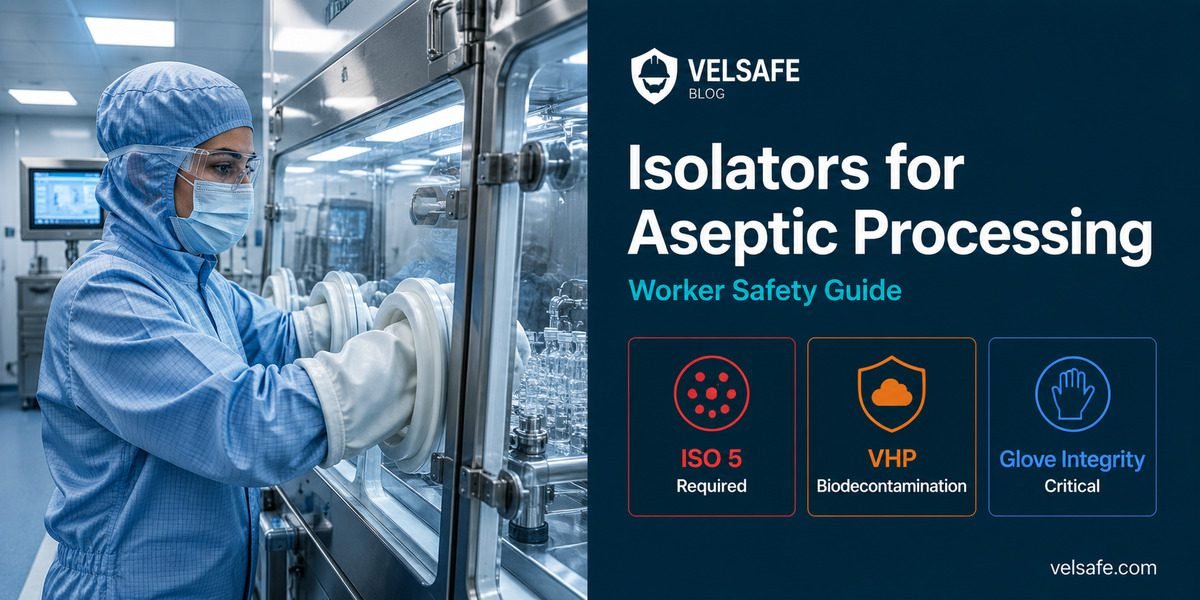
WORKER SAFETY: Aseptic Processing
What aseptic processing isolators are, why they matter for product sterility and worker protection, and what every operator, technician, and supervisor must know before working with them.
ISO 5
Required Air Class
Isolators used for aseptic filling must maintain an ISO 5 environment inside the working zone at all times during processing
FDA Aseptic Processing Guidance
<0.1%
Target Contamination Rate
Modern isolator technology supports sterility assurance levels that conventional cleanroom fills cannot consistently achieve
FDA, 2004
H2O2
Primary Biodecontaminant
Vaporised hydrogen peroxide (VHP) is the standard biodecontamination agent for pharmaceutical isolators worldwide
EMA GMP Annex 1
An isolator is a closed, controlled environment that separates the critical processing zone from the surrounding cleanroom and from the operators working near it. In aseptic pharmaceutical manufacturing, isolators are used to fill sterile drug products into containers without exposing the product to the open cleanroom environment or to direct human contact.
Every worker who operates, cleans, loads, unloads, or monitors an aseptic isolator needs to understand how it works, what it protects against, what can go wrong, and what their specific responsibilities are. A breach in isolator procedure does not just risk a batch recall. It risks patient harm.
Why Isolator Breaches Are a Patient Safety Issue
Sterile injectable products go directly into the bloodstream. A contaminated batch can cause sepsis, endotoxin reactions, and death. Isolator failures have led to product recalls, facility shutdowns, and criminal prosecutions. The FDA’s 2004 Aseptic Processing Guidance and EU GMP Annex 1 (2022) both treat isolator qualification and operator training as non-negotiable requirements. Understanding isolator operations is not background knowledge. It is a safety and compliance obligation.
Types of Isolators Used in Aseptic Processing
Positive Pressure Isolators
Used for aseptic filling of sterile drug products. Internal pressure is higher than the surrounding cleanroom, so air flows outward if a breach occurs. This protects the product from environmental contamination. Used for non-toxic, non-potent sterile products including most injectable biologics and small-molecule steriles.
Negative Pressure Isolators
Used for handling cytotoxic, potent, or highly active pharmaceutical ingredients (HPAPIs). Internal pressure is lower than surrounding environment, so air flows inward if a breach occurs. This protects the operator from exposure to hazardous substances. Used in oncology drug compounding, cytotoxic manufacturing, and high-containment research.
Restricted Access Barrier Systems (RABS)
RABS are not true isolators but are closely related barrier systems. They provide a physical barrier between operator and critical zone without full enclosure. Open RABS rely on unidirectional airflow for protection; closed RABS provide greater separation. RABS are often used where frequent manual interventions are required and full isolator integration is not practical.
Hazard Overview: What Can Go Wrong
Isolator Hazard Risk Profile
Glove breach or pinhole
Critical
VHP biodecontamination failure
Critical
Transfer port contamination
High
Pressure alarm ignored
High
HEPA filter degradation
High
Improper gowning on entry
Medium
Signs of Danger: When to Stop and Report
Stop processing immediately if you observe any of the following:
Any visible tear, hole, or discolouration in a glove or sleeve
Pressure differential alarm that does not clear within the approved recovery window
Visible particulates inside the isolator during fill operations
VHP residual reading above the post-biodecontamination limit before entry
Transfer port door opened in incorrect sequence or without completing the transfer cycle
HEPA filter integrity alarm or unscheduled smoke test failure
Any unplanned or uncontrolled intervention inside the critical zone
Environmental monitoring excursion (viable or non-viable particle count out of specification)
Step-by-Step: Operating an Aseptic Isolator Safely
1
Verify biodecontamination cycle completion before any entry
Confirm the VHP biodecontamination cycle has completed fully and that residual VHP levels are within the approved limit as recorded by the monitoring system. Never open glove ports or transfer systems before the cycle completion confirmation is in the batch record. Residual VHP above the limit is a respiratory and mucous membrane hazard.
2
Inspect gloves and sleeves before each use
Perform a visual inspection and a pressure integrity test on each glove and sleeve before starting any production activity. Most facilities use a glove integrity tester that inflates the glove to a defined pressure and monitors for decay. A glove that fails the test must be replaced before any work begins. Document the result in the batch record.
3
Follow the transfer port procedure exactly
Materials enter the isolator through validated transfer ports, typically rapid transfer ports (RTPs) or alpha-beta port systems. The transfer sequence is interlocked to prevent both doors from opening simultaneously. Follow the written procedure in the correct order. Never attempt to override an interlock. Never open the outer door without completing the surface decontamination step on the incoming item.
4
Monitor and respond to pressure differential readings
The isolator must maintain positive pressure differential against the surrounding cleanroom throughout the fill operation. Monitor the pressure display continuously. If a pressure alarm occurs, follow the written alarm response procedure: do not simply reset the alarm and continue. Determine the cause, document it, and escalate if the cause cannot be identified and resolved within the approved timeframe.
5
Document every intervention in real time
Any action taken inside the isolator during a fill operation is an intervention and must be documented at the time it occurs. This includes corrections to container positioning, removal of dropped components, and equipment adjustments. The batch record must accurately reflect every intervention. Undocumented interventions are a GMP deviation and a significant inspection finding.
6
Complete post-fill cleaning and closeout
After fill completion, follow the cleaning and closeout procedure exactly. Remove all materials from the critical zone using the transfer port sequence. Clean internal surfaces per the validated cleaning procedure. Remove and dispose of gloves according to site procedures. Complete all batch record entries before leaving the area. Never leave the isolator in an intermediate state between shifts.
Do and Do Not: Isolator Operation
Do
Perform glove integrity testing before every shift
Confirm biodecontamination cycle completion before any entry
Follow transfer port procedures in the documented sequence
Document interventions in the batch record in real time
Report any alarm that does not self-clear immediately
Wear your outer gloves over the integrated gloves at all times
Report any visible damage to gloves, sleeves, or seals immediately
Do Not
Override an interlock or bypass a safety system
Open glove ports before VHP residual is confirmed within limits
Reach into the critical zone without using the integrated gloves
Reset a pressure alarm without investigating and documenting the cause
Make undocumented interventions during fill operations
Continue a fill after a critical zone breach until QA has assessed
Leave the isolator in an intermediate or unlocked state between shifts
Emergency Response: Isolator Breach or Alarm
If a glove breach, pressure failure, or critical zone breach occurs:
1
Stop all fill operations immediately. Do not continue processing.
2
Note the time, the nature of the event, and the batch and fill stage at which it occurred.
3
Notify your supervisor and QA immediately. Do not attempt to assess the impact yourself.
4
Quarantine the filled units from the point of the breach. Do not release or move any product pending QA review.
5
Complete a deviation report with full details of the event. Cooperate fully with the investigation.
Supervisor Tips for Isolator Safety
Confirm training before assignment
Never assign an operator to isolator work without confirmed training completion and documented competency assessment. EU GMP Annex 1 (2022) requires training to include simulated aseptic processing. Training records must be current and on file before the operator touches the equipment.
Review glove integrity data regularly
Glove breach rates should be tracked by operator, by position, and by glove type. A pattern of breaches at a specific glove port position may indicate a mechanical issue with the isolator. A pattern linked to a specific operator may indicate a technique issue that requires additional training.
Treat every alarm as a real event
Repeated nuisance alarms lead to alarm fatigue, and alarm fatigue leads to missed critical events. If operators are regularly resetting alarms without investigation, the root cause of the alarm pattern must be investigated and resolved. A culture of alarm tolerance is incompatible with aseptic processing.
Isolator Safety Checklist
Before Each Shift
✓ Biodecontamination cycle completion confirmed
✓ VHP residual within approved limits
✓ Glove integrity test completed and documented
✓ Pressure differential reading within specification
✓ HEPA filter status confirmed (no pending alerts)
✓ Batch record and procedures available at point of use
During Operations
✓ Pressure differential monitored continuously
✓ All interventions documented in real time
✓ Transfer port procedure followed exactly
✓ Gloves inspected visually between fill stages
✓ Environmental monitoring samples collected per schedule
✓ Alarms responded to per written procedure
After Each Shift
✓ All materials removed from critical zone
✓ Internal cleaning completed per validated procedure
✓ Gloves removed and disposed of per site SOP
✓ Batch record entries completed and signed
✓ Isolator secured and status documented
✓ Any deviations reported and deviation form initiated
Key Takeaways
The isolator protects the product and the operator simultaneously
Positive pressure isolators protect sterile product from contamination. Negative pressure isolators protect operators from hazardous substances. Understanding which type you are working with determines the direction of the primary risk and the priority of your response if a breach occurs.
Glove integrity is the single most critical daily check
A pinhole in a glove that goes undetected can compromise an entire batch and expose product to contamination. Glove integrity testing is not administrative. It is the primary barrier between the operator and the critical zone. It must be performed and documented before every shift without exception.
Documentation is not paperwork : it is the legal record of what happened inside the isolator
Every intervention, every alarm, every transfer, and every glove test result must be recorded in the batch record at the time it occurs. During an FDA or EMA inspection, the batch record is the evidence. If an event is not documented, it did not happen from a regulatory standpoint. If it is documented incorrectly, it is a data integrity violation. Real-time, accurate, complete documentation is not optional in aseptic processing.
Frequently Asked Questions
What is the difference between an isolator and a cleanroom?
A cleanroom is a controlled environment where the entire room is maintained at a defined air cleanliness level. An isolator is a sealed enclosure within a room that maintains an independent controlled environment inside it. Isolators provide a higher level of product and operator separation than open cleanrooms because human operators work outside the critical zone, accessing it only through integrated gloves and validated transfer ports.
What is vaporised hydrogen peroxide (VHP) and why is it used?
VHP is hydrogen peroxide in vapour form, used to biodecontaminate the interior surfaces of the isolator before each production run. It is effective against bacteria, spores, viruses, and fungi at the concentrations used in pharmaceutical isolators. After the biodecontamination cycle, VHP is aerated out of the isolator and monitored to confirm residual levels are within safe limits before operator access. Residual VHP above permitted levels is a respiratory hazard.
What happens if a glove fails during a fill operation?
A glove failure during filling is a critical zone breach. All fill operations must stop immediately. The supervisor and QA must be notified. Units filled from the point of the breach must be quarantined pending a quality investigation. Depending on the nature and timing of the breach, the affected units may be rejected. A deviation report must be completed and a root cause investigation initiated.
How often must isolator gloves be replaced?
Glove replacement frequency is determined by the site’s validated glove change programme, which considers glove material, usage intensity, and integrity test failure rates. Most facilities replace isolator gloves on a defined periodic schedule regardless of visual condition, because degradation from VHP exposure and physical wear can compromise integrity before visible damage appears. The change programme must be validated and documented.
What is a rapid transfer port (RTP) and how does it work?
An RTP is a validated transfer system that allows materials to enter or exit the isolator without breaking the isolator’s controlled environment. It consists of an alpha port on the isolator wall and a beta port on a container or bag. When the two ports are connected and locked, the sealed interface between them is exposed and items can be transferred. The interlock prevents either port from opening while the other is disconnected, maintaining the isolator’s barrier integrity throughout the transfer.
What training is required before working with an aseptic isolator?
Training requirements are set by site SOPs and must comply with FDA Aseptic Processing Guidance (2004) and EU GMP Annex 1 (2022). At minimum, workers must be trained on aseptic technique, isolator-specific operating procedures, gowning and glove protocols, biodecontamination procedures, alarm response, intervention documentation, and media fill participation. EU GMP Annex 1 specifically requires that operators participate in simulated aseptic processing (media fills) to demonstrate competency before working on live batches.
What is environmental monitoring in the context of isolator operations?
Environmental monitoring (EM) in aseptic isolator operations involves sampling the air and surfaces inside the isolator during and after fill operations to detect any viable (microbiological) or non-viable (particulate) contamination. EM results are compared against alert and action limits defined in the site’s EM programme. An excursion above an alert limit triggers investigation. An excursion above an action limit triggers a formal deviation and may result in batch rejection.
Government and Regulatory Sources
Government and Regulatory Sources
- FDA. (2004). Guidance for Industry: Sterile Drug Products Produced by Aseptic Processing : the primary FDA guidance governing aseptic manufacturing, isolator use, environmental monitoring, and personnel training requirements.
- EMA. (2022). EU GMP Annex 1: Manufacture of Sterile Medicinal Products : the revised EU GMP standard covering isolator qualification, biodecontamination, glove integrity, and media fill requirements.
- USP. General Chapter 797: Pharmaceutical Compounding: Sterile Preparations : USP standards for sterile compounding including isolator and RABS requirements for pharmacy compounding environments.
- OSHA. Hazardous Substances in Healthcare : OSHA requirements for worker protection in environments involving hazardous pharmaceutical substances including cytotoxics handled in negative pressure isolators.
Related VelSafe Articles
Related VelSafe Articles
CONTINUE LEARNING
Know Your Isolator Before the Inspector Does
Aseptic isolator safety is one of the most inspected areas in sterile pharmaceutical manufacturing. Build your knowledge with more worker safety resources at velsafe.com.
Explore Worker Safety Articles