


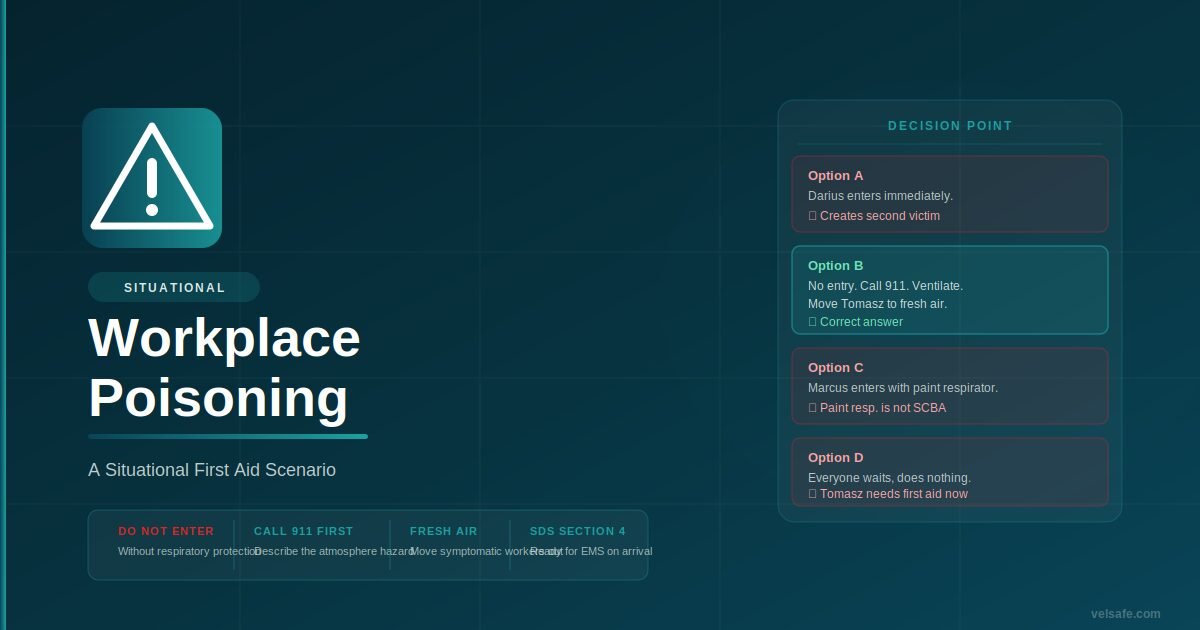
Two workers enter a spray finishing booth at a furniture manufacturing facility at the start of the afternoon shift. Within minutes, one of them comes out looking pale and unsteady, saying his co-worker is on the floor inside. The door to the booth is open. Three people are standing nearby. No one has gone in yet.
This scenario works through the decisions that must happen in the next 30 seconds, why scene safety overrides the instinct to help immediately, and what the first aider must do once the worker is out of the contaminated environment.
The Scenario
Location: Spray finishing booth in a furniture manufacturing facility. The booth is a semi-enclosed area approximately 14 by 20 feet with a ventilation system. The ventilation system was found to be malfunctioning this morning and a work order was submitted but not yet actioned. The booth contains open containers of lacquer thinner, a solvent-based finish, and cleaning rags.
The people: – Tomasz, the worker who came out of the booth and is now sitting on the floor outside it, confused and nauseous – Jorge, who is still inside the booth, unresponsive on the floor – Keisha, a production supervisor, who arrived on scene 20 seconds ago – Marcus, a maintenance technician, who is standing near the booth entrance – Darius, a co-worker with basic first aid training, who is at the booth entrance and about to walk in to help Jorge
Conditions: There is a strong solvent smell in the area near the booth entrance. The ventilation system is not running. Jorge has been inside the booth for approximately 8 to 10 minutes.
Decision Point
Darius is at the entrance and is about to enter the booth to reach Jorge. What should happen in the next 30 seconds?
Option A: Darius enters immediately to drag Jorge out. The quicker Jorge is out, the better.
Option B: Keisha directs Darius not to enter. She calls 911 immediately, assigns Marcus to ventilate the area if safe to do so from outside, and has Tomasz moved further from the booth. No one enters the booth until the atmosphere is confirmed safe or rescue-trained personnel arrive.
Option C: Marcus puts on a paint respirator from the maintenance shop and enters to help Jorge.
Option D: Everyone waits outside and does nothing until EMS arrives.
What is the correct response?
Analysis: Why Option B Is Correct
The atmosphere inside the booth is unknown and potentially immediately dangerous to life and health (IDLH). Solvent vapors at high concentrations can cause rapid loss of consciousness. If Darius enters without respiratory protection, he will be exposed to the same atmosphere that incapacitated Jorge, creating a second victim and worsening the outcome for both of them. The instinct to act immediately must be overridden by the scene safety principle that applies to any hazardous atmosphere incident.
The 911 call must communicate that this is a possible atmospheric hazard, not just an injured worker. “We have a worker down inside a spray finishing booth with a malfunctioning ventilation system and solvent fumes present” triggers a different EMS response than “worker collapsed.” Fire department rescue personnel equipped with SCBA will respond. EMS alone may not have the equipment to safely enter the booth.
Marcus may be able to activate additional ventilation from outside the booth or open access panels without entering. This reduces vapor concentration over time and may make safe entry possible sooner. Tomasz, who is already symptomatic, should be moved to fresh air further from the booth entrance, as solvent vapors can still be present near the open door.
Why the Other Options Are Wrong
Option A (Darius enters immediately) is the most dangerous choice. High-concentration solvent vapors can incapacitate a person within seconds. Darius entering the booth without respiratory protection is statistically likely to result in a second victim. This pattern, where a well-intentioned first responder enters a hazardous atmosphere and becomes incapacitated, accounts for a significant proportion of multiple-victim confined space and toxic exposure incidents. OSHA’s confined space and atmospheric hazard standards exist specifically because this scenario is common.
Option C (paint respirator entry) is also wrong. Paint respirators (particulate filtering facepieces or organic vapor cartridge respirators) used in spray finishing protect against particulate overspray and low-level vapor exposure under normal working conditions. They are not rated for IDLH atmospheres. If the vapor concentration is high enough to have incapacitated Jorge in under 10 minutes with the booth partially open, it exceeds the protection factor of a standard paint respirator. Only supplied-air respirators (SARs) or self-contained breathing apparatus (SCBA) are appropriate for this type of rescue entry.
Option D (do nothing) is wrong because Tomasz needs first aid and EMS needs to be called immediately. Waiting passively while doing nothing at all delays medical care for the worker who is already accessible and prolongs Jorge’s exposure inside the booth without the ventilation improvement that Marcus may be able to initiate from outside.
What Keisha Should Do: The Full Response Sequence
First Aid for Tomasz: Inhalation Exposure
Tomasz is conscious, nauseous, and confused. He has been exposed to solvent vapors and is in the early stages of acute inhalation exposure.
The Chemical Identification Question: CO vs. Solvent Fumes
One of the decisions EMS and fire personnel will need to make is whether the atmospheric hazard is solvent vapor (the likely cause given the scene), carbon monoxide (which can originate from combustion equipment), or a combination. The distinction matters for treatment, particularly for CO poisoning which requires high-flow oxygen.
Headache, dizziness, nausea, confusion, and loss of consciousness at high concentrations. Strong chemical smell in the work area. Rapid onset correlated with entering the space. Worker who leaves the area may improve in fresh air.
Headache, dizziness, nausea, and confusion, but no detectable odor (CO is colorless and odorless). Multiple workers affected simultaneously, especially near combustion sources. Cherry-red skin color is unreliable and rarely visible before hospital.
Regulatory Context: What the Employer Must Have in Place
This incident reveals several gaps that OSHA would examine in an investigation:
Learning Points
When a worker has been incapacitated by an atmospheric hazard, the most common error is an immediate entry attempt by someone without respiratory protection. This creates multiple victims and typically makes the outcome worse. The correct first move is to stop, assess, call 911, and ventilate from outside.
Standard spray finishing respirators are not rated for IDLH atmospheres. If the concentration has already incapacitated a worker, it exceeds what an organic vapor cartridge can handle. This distinction must be trained explicitly; many workers assume any respirator is protective.
Section 4 of the SDS (first aid measures) and Section 6 (accidental release) are relevant from the moment an exposure occurs. Having the SDS available for EMS on arrival is not a paperwork exercise: it determines what treatment is given in the first minutes after the worker reaches the hospital.
In post-incident reviews of chemical inhalation events, the consistent finding is not a lack of knowledge about SDS requirements. It is that SDS documents are stored in a central binder in the safety office, not at the point of use. In this scenario, the SDS for lacquer thinner is relevant at the booth, not in an office 200 feet away. First aid programs that place SDS documents only in a central location fail the accessibility standard precisely when accessibility matters most.
Related Resources
- OSHA, “29 CFR 1910.1000: Air Contaminants”
- OSHA, “29 CFR 1910.94: Ventilation (Spray Finishing)”
- OSHA, “29 CFR 1910.1200: Hazard Communication”
- OSHA, “29 CFR 1910.151: Medical Services and First Aid”
- OSHA, “Protecting Workers from Chemical Hazards” (OSHA Publication 3151)
- Poison Control Center: 1-800-222-1222 (24/7)
- AHA/Red Cross, “2024 First Aid Guidelines”