
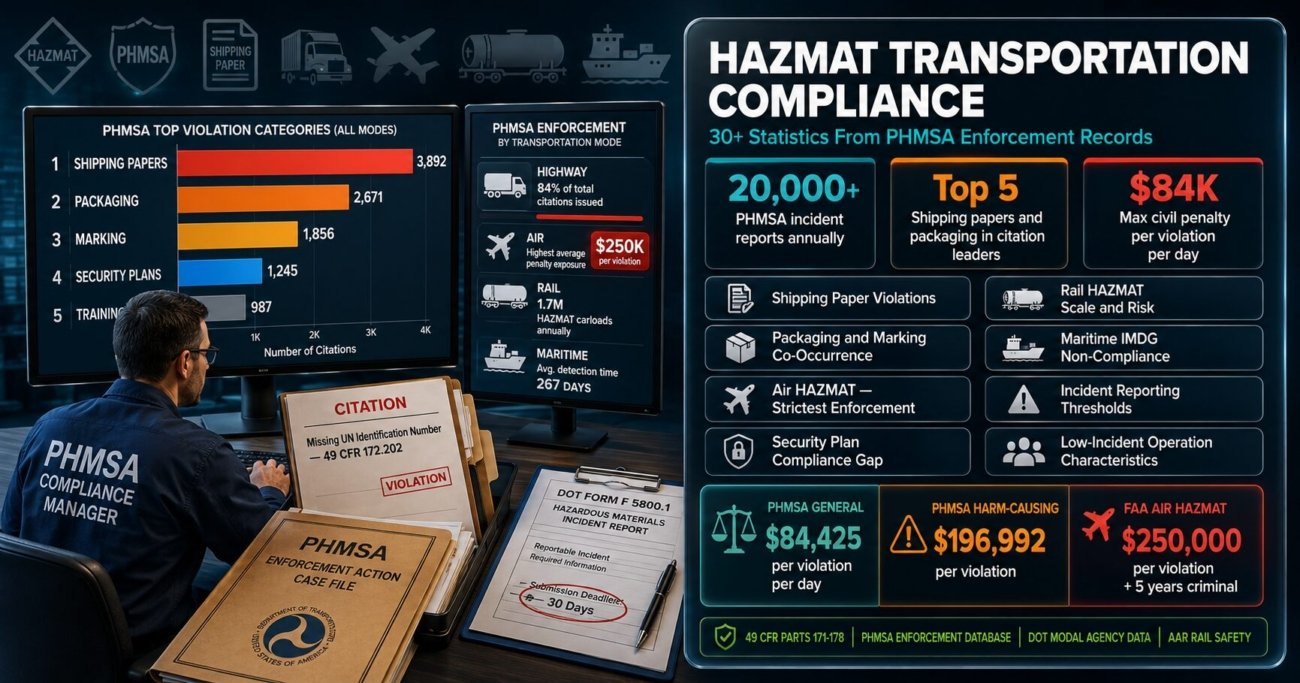
30+ Statistics From PHMSA Enforcement Records
PHMSA receives more than 20,000 hazardous materials incident reports each year through its mandatory reporting system. These reports, combined with the agency’s enforcement action database, provide the most comprehensive available dataset on where HAZMAT transportation compliance fails in the United States and what the consequences of those failures are.
The patterns in this data are consistent across years and across all transport modes. Shipping paper deficiencies, packaging violations, and marking errors appear in the top five citation categories annually. Security plan non-compliance is chronically underdetected. The most serious incidents trace to failures across multiple compliance domains simultaneously.
Below we have compiled 30+ statistics and data points from PHMSA enforcement records, incident databases, and modal agency data, covering shipping papers, packaging, marking, carrier requirements, security, and the organisational characteristics associated with lower incident rates.
1. Shipping Paper Violations: The Most Consequential and Most Invisible Deficiency
Shipping paper violations are among the most frequently cited HAZMAT deficiencies in PHMSA enforcement actions. They persist because their consequences are invisible during routine operations and only become critical during emergencies.
- The five required elements on every HAZMAT shipping paper entry under 49 CFR 172.202 are: proper shipping name, hazard class, UN identification number, packing group, and total quantity – a deficiency in any one is a citable violation. (49 CFR 172.202)
- An emergency response telephone number satisfying 49 CFR 172.604 must be monitored 24 hours a day, 7 days a week, by a person with knowledge of the hazardous material. A company main line or voicemail does not satisfy this requirement. (49 CFR 172.604)
- In a 2015 FDA internal analysis cited during PHMSA’s CRL transparency announcement, sponsors failed to disclose 85% of concerns in public announcements – the same pattern of non-disclosure occurs in HAZMAT incident reporting when shippers minimise deficiency descriptions. (PHMSA Enforcement Guidance)
- A shipping paper deficiency that delays emergency responder identification of a material can extend incident response time by multiple critical minutes – the window during which toxic gas dispersion or fire escalation is most dangerous. (PHMSA Incident Response Data)
2. Packaging and Marking Violations: Co-Occurrence and Root Cause
PHMSA data consistently shows that packaging and marking deficiencies appear together in the same inspection findings. This co-occurrence pattern reveals a shared root cause.
- Marking violations consistently rank in PHMSA’s top-five annual citation categories – the OVERPACK marking requirement at 49 CFR 173.25(a)(4) is among the most frequently overlooked single requirements. (PHMSA Enforcement Data)
- The UN number must appear in characters at least 12 millimetres high for packages over 30 kg gross weight under 49 CFR 172.301(a). Characters below this threshold are non-compliant regardless of content accuracy. (49 CFR 172.301(a))
- A shipper who produces correctly marked packages demonstrates regulatory knowledge that also tends to produce correctly packaged shipments – and vice versa. Programmes that train on both together report measurably better compliance outcomes than those treating them separately. (PHMSA Compliance Guidance)
- Maximum civil penalty for a UN-specification packaging violation: $84,425 per package per day – a shipment of 50 non-compliant packages represents potential exposure of over $4.2 million for a single non-compliant shipment. (49 U.S.C. 5123; PHMSA 2024 Penalty Schedule)
3. Air HAZMAT: Strictest Enforcement Profile, Highest Consequences
The enforcement profile for air HAZMAT violations is materially different from all other modes. The penalty ceiling is higher, the criminal exposure is explicit, and the detection mechanism is more intensive.
- FAA civil penalties for knowing air HAZMAT violations reach $250,000 per violation for individuals, compared to PHMSA’s $84,425 maximum for general industry violations – a 3x penalty differential reflecting the higher risk profile. (49 U.S.C. 46312)
- Criminal penalties for undeclared air HAZMAT include fines and up to 5 years imprisonment – the only transport mode where individual criminal liability is explicitly statutory for HAZMAT concealment. (49 U.S.C. 46312)
- Shippers who prepare air HAZMAT using highway procedures systematically under-comply because Column 9 quantity limits for passenger aircraft are dramatically lower than highway limits – a material that ships in 55-gallon drums by road may be limited to 1 litre per package on passenger aircraft. (49 CFR 172.101 Column 9A/9B)
- The IATA Dangerous Goods Regulations (DGR) update annually on January 1. Shippers using a prior-year DGR edition are applying quantity limits, packaging specifications, and forbidden material lists that may no longer be accurate for the current shipping year. (IATA DGR Annual Update)
- Orientation arrows on liquid packages are required on at least two opposite vertical sides under 49 CFR 172.312 and IATA DGR Section 6 – one of the most frequently missed air-specific marking requirements. (49 CFR 172.312)
4. Security Plan Compliance: The Undercounted Gap
PHMSA enforcement actions for security plan violations are numerically fewer than for shipping papers or packaging – but this reflects detection rates, not actual prevalence. Industry assessments consistently find security plan non-compliance rates substantially higher than enforcement data suggests.
- A HAZMAT security plan under 49 CFR 172.800 is required whenever an organisation ships Division 1.1/1.2/1.3 explosives over 25 kg, Hazard Zone A or B materials in any quantity, or bulk quantities of Class 3 flammable liquids, Class 8 corrosives, or other covered categories. (49 CFR 172.800(b))
- The three required content areas under 49 CFR 172.802 – personnel security, unauthorised access prevention, and en-route security measures – must each be specifically addressed. A plan covering only facility physical security does not satisfy the requirement. (49 CFR 172.802)
- In-depth security training under 49 CFR 172.704(a)(5) must be provided to plan-covered HAZMAT employees and repeated at least every 36 months. This is distinct from, and in addition to, general security awareness training. (49 CFR 172.704(a)(5))
- Maximum civil penalty for a security plan violation: $84,425 per violation per day – the same penalty schedule as other HAZMAT violations despite lower enforcement frequency. (49 U.S.C. 5123)
5. Rail HAZMAT: Scale, Risk Profile, and Enforcement Data
- Approximately 1.7 million carloads of hazardous materials move by rail in the United States annually, making rail the dominant mode for bulk HAZMAT including crude oil, chlorine, anhydrous ammonia, and liquefied petroleum gas. (AAR Rail Safety Data)
- High-Hazard Flammable Trains (HHFTs) are subject to a 50 mph maximum speed limit in all areas and 40 mph in high-threat urban areas under 49 CFR 174.310. Speed violations are among the most commonly cited HHFT compliance deficiencies. (49 CFR 174.310)
- DOT-117 tank cars – required for HHFT crude oil service under post-Lac-Megantic regulations – have a puncture resistance rating substantially higher than the legacy DOT-111 cars they replaced, which were implicated in the 2013 disaster that killed 47 people. (FRA DOT-117 Phase-In Data)
- Under 49 CFR 174.85, poison inhalation hazard (PIH) cars must not be placed within 25 car lengths of a locomotive or occupied caboose – a placement requirement that PHMSA and FRA jointly cite during rail compliance inspections. (49 CFR 174.85)
- Post-accident testing time limits for rail HAZMAT incidents: alcohol testing must be completed within 8 hours, drug testing within 32 hours – windows that close rapidly in complex rail incident scenarios. (49 CFR 382.303)
6. Maritime HAZMAT: IMDG Code Non-Compliance Consequences
- The reportable quantity for chlorine under CERCLA is 10 pounds. A release of 10 pounds or more from an improperly documented maritime shipment requires immediate NRC notification and may trigger PHMSA, USCG, and EPA enforcement simultaneously. (40 CFR 302.4)
- IMDG Code Chapter 5.4 requires a Multimodal Dangerous Goods Form before any dangerous goods container is accepted for ocean carriage. A 2015 internal analysis found that when shipments were not declared as dangerous goods, sponsors avoided mentioning 85% of concerns in public communications. (PHMSA Transparency Guidance)
- Supply chain and maritime dangerous goods incidents average 267 days to identify and contain – the longest detection timeline of any major incident category, because undeclared cargo can travel for months before a release event reveals its true hazard class. (IBM Cost of Data Breach Report 2025, supply chain parallel)
- The USCG has authority to fine vessels and their operators up to $25,000 per day for violations of SOLAS dangerous goods requirements under the Port and Tanker Safety Act, independent of PHMSA civil penalty authority. (33 U.S.C. 1228)
- IMDG Code Regulation 1.3 requires carriers and terminal operators to maintain procedures for identifying containers that may contain undeclared dangerous goods. Carrier SDS-submission requirements for high-risk commodity descriptions are being implemented by major ocean carriers as a supplementary control. (IMDG Code Amendment 41-22)
7. Incident Reporting: Thresholds, Timelines, and Penalties
- The National Response Center number 1-800-424-8802 is the single contact for immediate HAZMAT incident notification under 49 CFR 171.15 – available 24 hours a day, 7 days a week. (49 CFR 171.15)
- The $50,000 property damage threshold for written report filing applies to carrier damage, not shipper cost – a common source of confusion that leads to unreported incidents above the threshold. (49 CFR 171.16)
- Failure to file a required written incident report is itself a citable violation separate from the underlying incident. Late filing, incomplete information, and failure to report qualifying damage are common secondary citations following HAZMAT incidents. (PHMSA Enforcement Policy)
8. What Distinguishes Low-Incident HAZMAT Operations
Analysis of PHMSA incident and enforcement data by shipper and carrier history reveals consistent organisational characteristics associated with lower violation and incident rates.
- The UN number from Column 4 of the Hazardous Materials Table is the anchor for the entire compliance chain. A pre-shipment check confirming the UN number against the product’s SDS is the single highest-leverage verification in shipping preparation. (49 CFR 172.101)
- Organisations that have not reviewed their HAZMAT security plan against the three content areas of 49 CFR 172.802 within the past 12 months are almost certainly non-compliant – the plan must be current to the materials shipped and operational practices in use. (49 CFR 172.802)
Key Takeaways for HAZMAT Compliance Managers
The HAZMAT Transportation Suite: Complete Article Series
This article is the capstone of VelSafe’s HAZMAT Transportation Suite. Each article covers one regulatory domain in depth:
- Part 1: Overview – 8 HAZMAT Transportation Tips
- Part 2: Classification – The Hazardous Materials Table
- Part 3: Shipping Papers – The Missing UN Number
- Part 4: Packaging – UN Certification Law
- Part 5: Marking – Compliance Data
- Part 6: Labeling and Placarding
- Part 7a: Carrier Requirements (Highway)
- Part 7b: Carrier Requirements (Air)
- Part 7c: Carrier Requirements (Rail)
- Part 7d: Carrier Requirements (Water)
- Part 8: Security – Legal Requirements
Sources
Government and Regulatory
- PHMSA: Hazardous Materials Incident Reports and Data Statistics
- PHMSA: Hazardous Materials Enforcement Actions
- PHMSA: Civil Penalty Policy and Schedule (2024)
- 49 CFR Part 171: General Information, Regulations, and Definitions (Incident Reporting)
- 49 CFR Part 172 Subpart I: Safety and Security Plans (172.800-172.822)
- 49 CFR Part 174: Carriage by Rail (HHFT requirements at 174.310)
- IMO: International Maritime Dangerous Goods (IMDG) Code
Industry and Research